
June 1, 2026 in Thought leadership
How Leading Credit Unions Turn Cross-Sell Into Deeper Member Growth
Discover how leading credit unions use digital experiences, predictive modeling, unified platforms, and behavior-driven engagement to turn cross-sell into a member-first growth engine.

Consumers now judge every financial interaction against their best digital experiences, not just against other credit unions. Streaming services, e-commerce giants, and ride-hailing apps have trained people to expect intuitive, personalized journeys that anticipate needs in real time. For credit unions, that shift turns cross-sell from a product promotion tactic into a strategic way to deepen relationships and drive sustainable growth.
At the same time, the competition for primary relationships is intensifying. Forrester finds that a strong majority of consumers in major markets expect to complete any financial task through a mobile app, which raises the bar for mobile-led, omnichannel experiences. EY and Accenture research also shows that members increasingly spread their business across multiple providers, making it harder for any single institution to earn full wallet share and long-term advocacy.
The good news is that leading credit unions are already showing what smarter cross-sell looks like in practice. Their experiences point to five lessons that any institution can adapt to build a member-first, growth-ready cross-sell strategy.

Lesson 1: Deliver high-performing app experiences that feel effortless
Members do not distinguish between a digital banking session and their favorite shopping app. They expect fast load times, prefilled forms, clear progress indicators, and the ability to start on one device and finish on another. FICO’s recent survey confirms how high the stakes have become: 88% of respondents say a bank’s customer experience is as important or more important than its products and services when choosing a provider.
For credit unions, that means friction is now a loyalty risk. Every extra field, confusing step, or broken handoff creates an opportunity for members to abandon the journey and look elsewhere.
Digital leaders respond by:
- Treating every application like an ecommerce checkout, with clear steps and minimal effort required.
- Using prefill and saved sessions so members can pause and return when it is convenient.
- Ensuring performance and usability are consistent across mobile, desktop, and in-branch experiences.
High-performing digital experiences are the foundation of any cross-sell strategy. Members will only explore new products when their everyday interactions feel simple and reliable
Lesson 2: Move from reactive service to predictive, member-first models
Traditional cross-selling relies on a member raising their hand. Leading credit unions are flipping this script by using real-time data to anticipate needs before they are articulated. By shifting from reactive responses to predictive guidance, institutions can deliver value at the exact moment a member requires it, for example, surfacing a HELOC offer when spending patterns suggest a home renovation is underway.
Read our deep dive on moving from reactive to predictive engagement in “From Reactive to Predictive: Unlocking Deeper Member Engagement.”
This shift means moving away from static, one-time campaigns toward a continuous, data-informed engagement model that treats cross-sell as a member service rather than a sales motion. It relies on insights from behavior, life events, and channel activity to make every offer feel timely, relevant, and genuinely helpful.
Lesson 3: Power cross-sell with a single, unified platform
Mindset is essential, but it is hard to act on predictive insights if data lives in silos across the institution. Many credit unions still rely on separate systems for core banking, online and mobile banking, loan origination, CRM, and analytics. That fragmentation creates two major problems:
- Staff never see a complete picture of the member’s relationship and recent activity.
- Digital channels cannot deliver consistent, context-aware experiences across devices and touchpoints.
Research from EY shows that many consumers now maintain relationships with multiple financial institutions. In that environment, a credit union’s advantage comes from unifying its own data so teams can see the full relationship with each member, offer more relevant solutions over time, and respond quickly when needs change.
A single origination and engagement platform helps solve this problem. Instead of stitching together disjointed tools, a unified layer can:
- Consolidate data from browsing behavior, applications, digital banking, and CRM into a single member view.
- Coordinate cross-sell offers that appear consistently whether the member is in a branch, on mobile, or on the web.
- Provide staff with the same real-time context the member sees, enabling more human, needs-based conversations.
Blend’s Consumer Banking Suite is designed with that unified model in mind for credit unions. With one configurable platform, institutions can support deposit accounts, consumer loans, and home lending all while embedding cross-sell logic into each journey.
Lesson 4: Use member behavior to make cross-sell feel personal
Traditional cross-sell assumes that once someone becomes a member, they should receive the same offers as everyone else. That one-size-fits-all approach no longer holds. Members expect their credit union to recognize who they are, what they prefer, and where they are in their financial journey.
Behavior-driven cross-sell starts with listening to the signals members already provide, including:
- Channel preferences: whether they primarily engage through mobile, desktop, or in-branch.
- Location context: where they are transacting and what that implies about current needs.
- Application behavior: where they abandon or pause, and what might help them get unstuck.
- Spending and saving patterns: indicators of milestones such as car purchases, family changes, or home moves.
Leading credit unions turn these signals into smart engagement:
- Some tailor messaging and notifications to the member’s preferred channel so that the same offer feels helpful rather than intrusive.
- Others use location-based intelligence to surface multiple relevant products when a member is, for example, shopping for a car and might benefit from pre-approved financing or insurance.
- Many experiment with “shopping cart” experiences that let staff and members explore multiple products in one conversation, making it easier to bundle solutions instead of pushing single offers.
When behavior drives the conversation, cross-sell stops feeling like a sales tactic and starts to resemble personalized financial coaching. Members see that the institution is paying attention in ways that make their lives easier, which encourages them to keep more of their financial activity under one roof.
Lesson 5: Build a phased cross-sell roadmap instead of trying to do everything at once
Knowing what great cross-sell looks like is not the same as having the capacity to build it overnight. Many credit unions operate with lean teams and complex legacy stacks. Attempting to deliver predictive modeling, omnichannel orchestration, and full data integration in a single push can stall progress and exhaust stakeholders.
The institutions that succeed take a phased approach that builds momentum through visible wins.
Step 1: Build the foundation
- Establish baseline metrics for digital applications, product adoption, and member satisfaction. Identify where friction is highest and where members most often drop off.
- Deploy analytics that clarify when and where cross-sell feels natural versus disruptive.
- Launch one focused use case, such as a targeted renewal campaign for a specific product or a simple shopping cart pilot. Use the results to validate value and refine assumptions.
- Invest in staff education so everyone understands why processes are changing and how new tools support better member outcomes. Many leaders report that change management, not technology, is the hardest part of the journey.
Step 2: Focus on integration
- Move toward a single source of truth for member data, even if it starts with a limited set of products or segments.
- Connect core, digital, and CRM systems through APIs and platform capabilities so that cross-sell decisions draw on consistent information.
- Consider “invisible” signals such as direct deposit patterns and income changes that can indicate when members may be most receptive to offers, like after a raise, bonus, or new job.
Step 3: Grow the relationship
- Create a small set of practical member personas (start with two or three) that reflect real financial journeys, then map products and experiences to each persona. Over time, you can expand to a handful of distinct personas as your cross-sell strategy matures.
- Analyze transaction data to identify moments where a timely suggestion would truly help the member, such as consolidating debt or building an emergency fund.
- Layer in automation and predictive tools to scale those insights, ensuring staff can focus on the highest value conversations.
Step 4: Turn data into smarter recommendations
Unified data is only powerful when it is put to work. Leading credit unions are turning the insight into actionable, member-centric recommendations that feel timely and relevant and not promotional. By applying data science and AI models to their unified member view, they can detect meaningful life events (a new direct deposit, increased debit activity, or recurring childcare) and translate them into personalized guidance, such as suggesting a high-yield savings account or a refinancing opportunity.
This roadmap keeps the focus on continuous improvement rather than a one-time transformation. Each phase adds measurable value, reinforces internal confidence, and prepares the organization for more advanced capabilities.
Looking ahead: AI, invisible banking, and the future of member-first cross-sell
Cross-sell is already evolving beyond traditional campaigns toward experiences that feel almost invisible to the member. In the future, account openings may happen automatically through employers, and contextual offers will appear seamlessly within major purchase journeys, like home or auto shopping. Members will not think of these as promotions. They will experience them as timely guidance that fits naturally into what they are already doing.
AI is a critical enabler of that future. Institutions that integrate AI with real-time data and unified platforms can:
- Build a more complete, up-to-date picture of each member’s needs and intent.
- Orchestrate offers consistently across digital and people-led channels.
- Continuously learn which experiences deepen advocacy and which create friction.
Blend’s Consumer Banking Suite empowers credit unions to build deeper member relationships by embedding intelligent cross-sell directly into origination journeys and providing tools to personalize offers from the very first interaction.
Credit unions that embrace this member-first, AI driven model can turn cross-sell into a durable advantage that strengthens relationships, increases lifetime value, and helps members achieve lasting financial wellness. With the right experiences, data, platform, and roadmap, they can deliver on that promise at scale and secure their place as trusted partners in every major financial moment.

Ready to reimagine cross-sell for your members?
Find out what we're up to!
Subscribe to get Blend news, customer stories, events, and industry insights.
Autopilot Update: Navigator is in Beta, and It Can Price a Loan
A loan officer can now ask Navigator to price a loan, see which products it is eligible for, and select one.
Read the article about Autopilot Update: Navigator is in Beta, and It Can Price a Loan
Intelligence Spotlight: How much faster does closing paperwork reach borrowers with Autopilot?
Closing disclosures go out 2-4 days sooner with Autopilot. The reason: files get fixed at intake, not after the borrower commits.
Read the article about Intelligence Spotlight: How much faster does closing paperwork reach borrowers with Autopilot?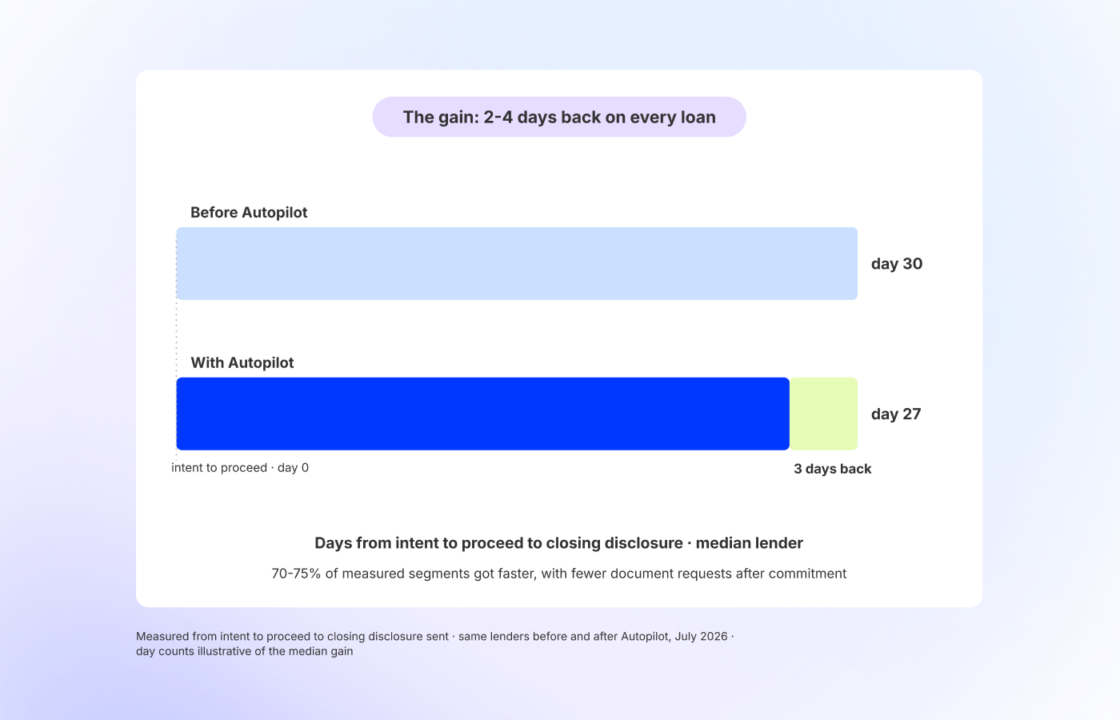
Unbound: Five Takeaways from Blend Forum 2026
Explore five takeaways from Blend Forum 2026 on the shift from technology to capacity, the changing role of employees, and the future of lending.
Read the article about Unbound: Five Takeaways from Blend Forum 2026