July 27, 2026 in Thought leadership
How Lenders Can Reach More Bilingual Borrowers Without Adding Friction
As bilingual borrower demand grows, lenders can reach more borrowers and capture more market share by creating clearer mortgage experiences.

Bilingual borrowers have long been part of the mortgage market, but the scale of the opportunity has increased, which makes the experience lenders offer more important.
As household formation and homeownership growth increasingly come from diverse communities, lenders have a larger opportunity to reach borrowers who may move between languages, involve family more deeply in financial decisions, or want more confidence in what they are signing before they move forward. That shift is making one thing clearer: reaching more bilingual borrowers is not simply a matter of language access. It is also a matter of designing a mortgage experience that feels easier to understand and easier to complete.
For many institutions, that is where the tension begins. The opportunity is real, but so is the concern that any new support model could add complexity to origination, create more work for internal teams, or slow the process at key moments. The better question is not whether lenders should support bilingual borrowers more effectively. It is how to do that in a way that expands reach, strengthens borrower confidence, and still keeps loans moving.

A market lenders can no longer afford to overlook
The business case starts with the shape of the market itself. According to NAHREP’s 2025 State of Hispanic Homeownership Report, which cites government data, Hispanic households accounted for 1.094 million new households in 2025, representing 92.6% of U.S. household formation growth. The same report found that Hispanic homeownership reached 10.2 million homeowners that year, and that without Hispanic buyers, the U.S. would have seen a net loss of about 125,000 homeowners.
Those numbers do not point to a niche audience. They point to a borrower population that is already influencing housing demand and will continue to shape where future growth comes from. For lenders, that makes the borrower experience more commercially important, not less. Institutions that make the mortgage journey easier to navigate for bilingual borrowers are likely to be better positioned to expand reach, strengthen relevance, and capture more market share in growing communities.
Many lenders are already serving bilingual borrowers in some capacity. The opportunity now is to create experiences that make it easier to earn trust, expand reach, and win more business in growing markets.
Translation is only the starting point
Translation is a logical place to start, but it is rarely the whole answer. Mortgage documents are dense, technical and often difficult for borrowers to interpret, even when they are fully comfortable in English. Translating that same complexity into another language can improve access, but it does not automatically create understanding.
That distinction matters because borrower confidence is usually built in moments that are full of detail, paperwork and financial consequence. A borrower may be comfortable speaking English in everyday life but still want to review closing costs side by side in Spanish before signing. In that moment, what matters most is not just access to another language. It is confidence that the numbers, terms and next steps all make sense.
The lenders that stand out in this market will not simply translate more documents. They will make the process easier to understand by helping borrowers connect information to their actual loan, their actual costs and the decisions they are being asked to make.
Bilingual borrowers do not all move through mortgage the same way
The needs and preferences of bilingual borrowers can vary throughout the mortgage journey. Some may prefer to compare information across languages. Some may switch languages depending on the task. Some may be fully fluent in English and still feel more confident reviewing high-stakes financial details in another language.
In many cases, the decision process is broader than the named borrower on the loan. A parent, partner or other family member may be part of the conversation, and that person may be more comfortable reviewing key details in another language. A standard borrower experience can miss that reality even when the loan itself is still progressing normally.
Serving bilingual borrowers well does not require turning every interaction into a separate process. It requires understanding that clarity is not always individual, and that a more adaptable experience can better reflect how many households evaluate major financial decisions.
Friction tends to show up in a few familiar places
When lenders think about operational drag, it helps to be specific about where it usually comes from. In mortgage, the highest-friction moments are often the same ones borrowers find hardest to interpret: disclosures, closing costs, and signing.
These are the stages where uncertainty can quickly turn into hesitation, repeated questions or avoidable back-and-forth. If a borrower cannot easily connect what they are seeing to what they expected, momentum can start to slow. That is especially true when support sits outside the main workflow and borrowers have to leave the process to find answers.
A common example is the loan officer who ends up answering the same disclosure questions over email or phone after the borrower leaves the portal confused. Another is the borrower who receives translated materials in one place and loan documents in another, then has to piece together what applies to their loan on their own. In both cases, the friction is not coming from serving bilingual borrowers. It is coming from the gap between what the borrower needs to understand and how support is being delivered.
Better support does not have to slow the process
It is common to assume that incorporating better support for bilingual borrowers will make the process more complex. In practice, the more important tradeoff is not between borrower support and efficiency. It is between building support into the experience or relying on workarounds.
When support depends on separate documents, off-platform explanations or a handful of employees acting as the translation layer, the process becomes heavier for everyone. Borrowers have more places to look for answers, teams spend more time repeating the same explanations and consistency becomes harder to maintain across channels and branches.
By contrast, when support is embedded into the borrower journey, it can reduce friction rather than create it. Borrowers are able to get answers at the moment they need them. Internal teams spend less time filling avoidable clarity gaps. The process feels more connected because support is part of the experience, not something layered on top of it.
That could be as simple as surfacing a clearer explanation of the Loan Estimate in the same environment where the borrower is already reviewing disclosures. Instead of sending the borrower somewhere else or relying on a follow-up call, the lender keeps guidance inside the workflow and preserves momentum.
The lenders that win will make clarity part of the experience
For institutions thinking about how to act on this opportunity, the starting point does not need to be a complete redesign. In most cases, the best place to begin is with the moments where confusion is most likely to affect confidence and momentum.
A lower-friction approach usually has a few things in common. It prioritizes loan-specific explanations over generic education. It keeps support inside the workflow instead of sending borrowers somewhere else. It gives internal teams tools that help them guide borrowers without requiring them to become the only bridge between the documents and the borrower.
The institutions best positioned to win more share in this market will be the ones that make support feel native to the experience and easier to scale. They will not treat bilingual borrower support as a separate track. They will treat it as part of building a clearer, more effective mortgage journey.
Ready to reach more borrowers in growing markets?
Bilingual borrowers are a growing part of the mortgage landscape, and many lenders have a bigger opportunity to reach them more effectively. The advantage will go to lenders that make it easier for bilingual borrowers to navigate key mortgage moments with confidence. The ones that stand out will make the process easier to understand, easier to navigate, and easier to complete.
As lenders look for new ways to differentiate, that kind of clarity can become a meaningful competitive advantage. Lenders that make the experience clearer can build trust earlier, reduce unnecessary back-and-forth, and create a smoother path to close for more borrowers.
With Blend and Talk’uments, lenders can make multilingual, loan-specific guidance part of the borrower experience, helping borrowers stay informed while keeping the process moving.

Want to learn how Blend and Talk’uments can help you reach more bilingual borrowers without adding friction?
Find out what we're up to!
Subscribe to get Blend news, customer stories, events, and industry insights.
Home Equity Is the Proving Ground
See how faster digital origination can improve share, pull-through, and lifetime customer value.
Start learning about Home Equity Is the Proving Ground
Winning the Account Isn’t the Same as Winning the Customer
Opening an account is easy. Keeping it active isn't, and the usual metrics don't always capture the difference.
Read the article about Winning the Account Isn’t the Same as Winning the Customer
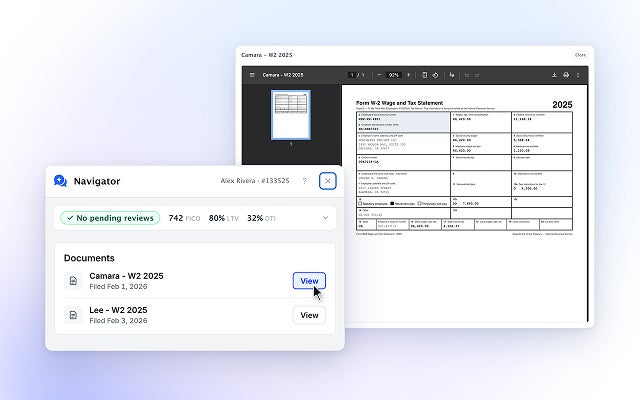
Autopilot Update: Navigator Shows Its Work
The document, the disclosure status, the next step. All in the conversation.
Read the article about Autopilot Update: Navigator Shows Its Work