
August 12, 2026 in Blend momentum
Autopilot Update: The Early Results Are In. Now We’re Making Them Repeatable.
The production numbers came from real loans in real workflows. This update is about the infrastructure that makes those numbers hold up at scale.

In recent updates, we’ve talked about Blend’s shift toward becoming an agent-first company: using agents inside our own operations, learning what it takes to make them useful and reliable, and applying those lessons to the products we build for our customers.
Last week’s earnings call put some numbers behind that progress.
Inside Blend, our engineering team is now shipping at 3.6 times its January throughput with roughly the same headcount, up from 1.5x in May. This period alone included roughly 200 changes to Autopilot.
On the customer side, Autopilot has assisted more than 45,000 loans since starting from zero in March. More than 65 lenders activated it during the preview, and six have signed contracts since commercial availability began July 1.
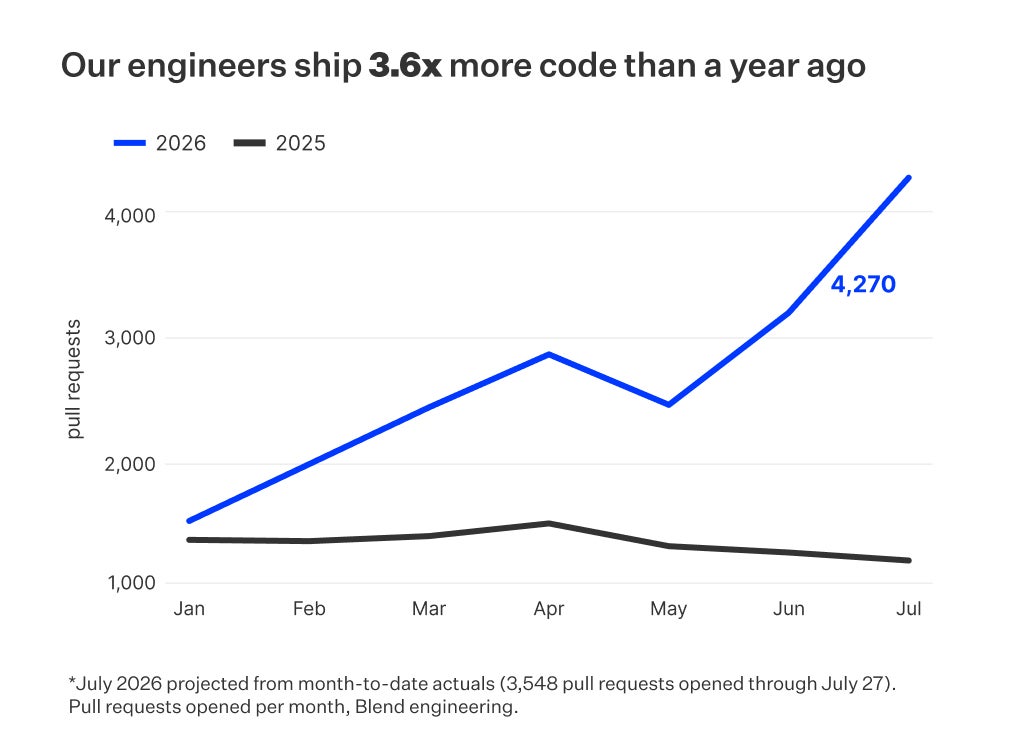
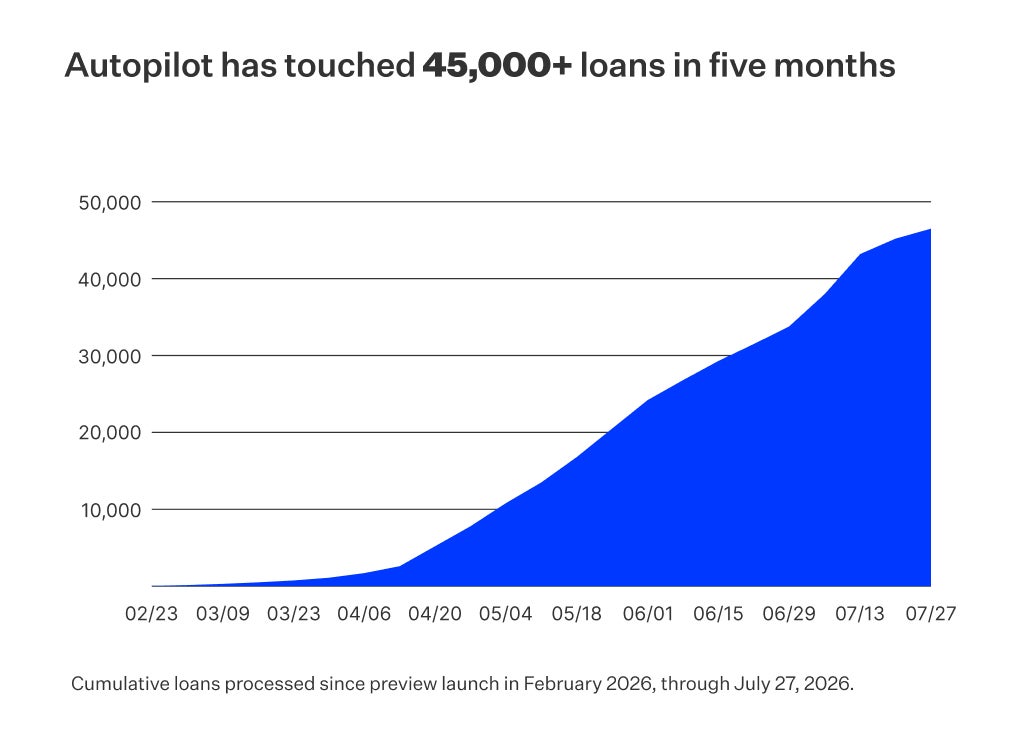
The early production results are especially encouraging: preliminary data points to a 10% to 15% improvement in pull-through, two to four days of cycle time improvement, and roughly 4.5 hours of fulfillment work automated per loan.
Those are meaningful early results, particularly because they come from real loans moving through real production workflows. Autopilot is working with borrowers, documents, conditions, policies, and loan teams, not operating in a demo or controlled environment.
Our own agent-first transformation gives us a useful vantage point on what it takes to make this model work: where agents need guardrails, how workflows have to change around them, and what teams need in order to include them with more work. We are bringing those lessons into Autopilot as we help lenders make the same transition.
The work in this update is part of that effort. Over the past two weeks, we focused on a practical set of improvements across the loan workflow: preserving borrower conversations in the loan file, making the pre-underwriting summary more trustworthy, eliminating unnecessary borrower requests, simplifying income evaluation while supporting lender-specific rules, and strengthening the evaluation and reliability systems underneath the agent.
They are different changes, but they all move Autopilot in the same direction: toward being a more dependable part of the lending operation as it takes on more volume and more complexity.
Let’s dive into the latest improvements.
Borrower conversations now stay with the loan
More than half of borrowers apply outside business hours. That makes borrower chat an important part of how Autopilot supports a loan when a loan officer may not be available, whether that is late at night, over the weekend, or simply between borrower and loan team touchpoints.
Until now, those conversations were temporary. Blend purges chat messages after fifteen days, and lenders consistently asked for a way to retain the record with the loan.
Autopilot now does that automatically when enabled. After a quiet period following the last message, the conversation is rendered as a PDF and uploaded to the loan file before the underlying chat is purged. Each borrower gets a separate transcript, so a co-borrower’s conversation never ends up in someone else’s document.
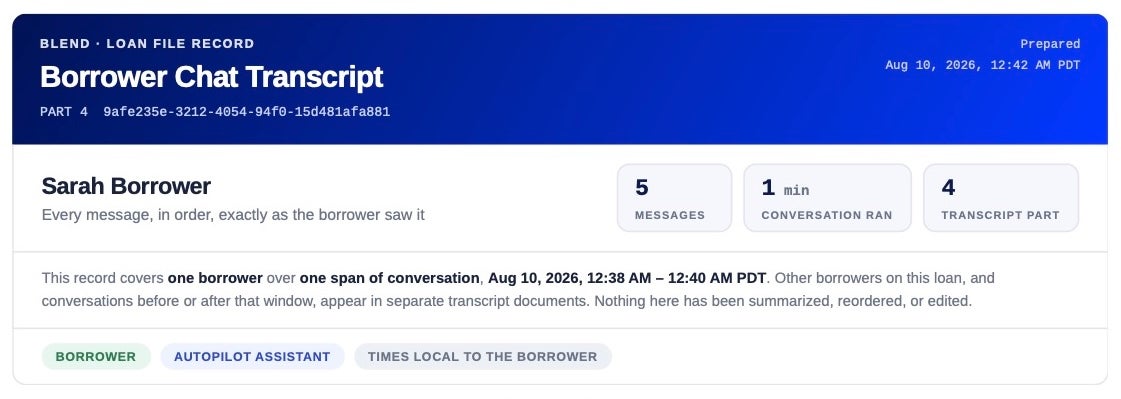
There are two important controls around how it works:
- Retention is off by default and enabled per lender. Some lenders do not want chat transcripts retained in the loan file, so that records decision stays with them.
- Filing a transcript does not trigger Autopilot. Uploading the agent’s own conversation does not cause it to review or act on that document again.
Today, transcripts are filed separately by conversation window. We are also working toward a single cumulative transcript for the life of the loan.
A summary that files where underwriters look
Our last update covered the rebuilt pre-underwriting summary, including the source information behind the figures it presents. This period, we focused on making that summary fit more naturally into the way lenders actually work: where it appears, how its numbers reconcile, and how clearly it distinguishes what Autopilot infers from what is actually known.
The summary is now a dedicated Blend document type. Instead of landing in a generic location in the loan file, it files where an underwriter would expect to find it.
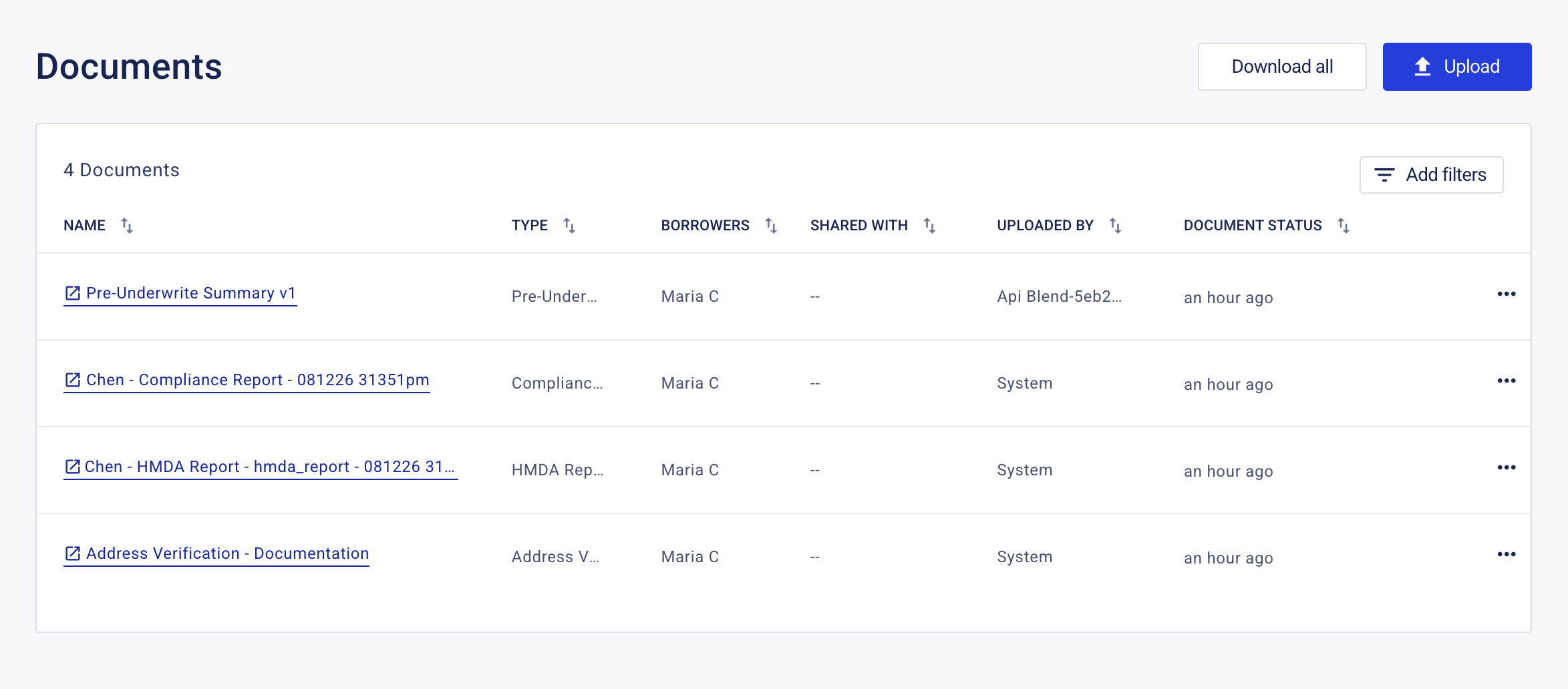
The numbers inside it also now reconcile with the rest of the loan file. Debt-to-income, for example, comes from the same canonical calculation displayed in the lender UI, including after a credit pull. An underwriter should no longer see one DTI in the summary and another elsewhere in the file.
We also made the status of individual figures much clearer:
- Every income line is marked verified or awaiting: The reader can immediately distinguish income Autopilot inferred against documentation from income that is still borrower-declared.
- Income calculations show how they were derived: Trend and comparison steps no longer appear as dollar results.
- Declared assets are not presented as verified: If Autopilot has not reviewed supporting documentation, the summary makes that clear.
- An empty credit section now says “No credit report on file”: Previously, it read “N/A — needs attention,” suggesting there was an issue when there was simply nothing to review yet.
The goal is simple: if a loan officer or underwriter is going to use the summary to make a decision, they should not have to double-check whether it agrees with the rest of the file.
Fewer wrong asks
Subscribe to Autopilot updates
Accuracy is not only about what Autopilot identifies. It is also about knowing when not to ask a borrower for something.
An unnecessary document request creates work on both sides. The borrower has to figure out what is being asked for, and someone on the loan team eventually has to review or clear the response. It also makes the agent less trustworthy, especially when the borrower has already provided the information.
This period, we eliminated several of those cases:
- No original-purchase HUD-1 on a refinance loan: That request makes sense in certain purchase scenarios but was appearing on files where it did not apply.
- No HOA bill when the mortgage statement already contains the information: Autopilot can now use the line item already available instead of asking the borrower for another document.
- No duplicate W-2 requests for the same year: Requests now carry an explicit year, and documents already on file suppress redundant employment verification.
- No letter of explanation for aged credit inquiries: Inquiries beyond the relevant timeframe no longer generate an unnecessary request.
- No undisclosed-debt flag for debt the borrower already disclosed: Autopilot checks the application before treating an account as undisclosed.
- No sourcing request for a debt or lien payoff: A payoff is not treated like a deposit that needs to be sourced.
We also added two protections around work the loan team has already done. Autopilot can no longer cancel a follow-up that a person created manually, and it no longer renames or reclassifies documents synced from the system of record.
The principle is straightforward: when the loan team has made an intentional decision, the agent should respect it.
One income step, with room for lender-specific rules
Income evaluation previously happened across several stages. Each stage needed its own instructions about which guidelines applied and what type of income it was evaluating, creating more opportunities for those steps to disagree.
We have consolidated that work into a single income evaluation step. It identifies the income type, retrieves the appropriate guidelines, and evaluates the documentation together.
That produces a more consistent qualifying figure, particularly for income such as overtime, bonus, and commission, where the answer depends on both the documents and the rules used to interpret them.
The same step can also incorporate lender-specific overlays. A lender’s own income policies can sit on top of the agency baseline, and documentation requirements can be applied to individual income components rather than as one blanket rule.
That ability to bring a lender’s own logic into Blend extends beyond income. It is also part of the thinking behind the MCP Server, which Onity is using as infrastructure for its own voice agents. Rather than forcing customers to work around Blend, we want them to be able to build their own workflows and intelligence on top of it.
The MCP surface continued to expand this period:
- Borrower-request data now includes due dates, ping history, and who requested and completed each item.
- Disclosure status shows who sent a package and where it currently stands.
- Error responses explain what happened instead of returning only a status code.
Improving accuracy and reliability underneath the workflow
Some of the most important changes this period are not things a borrower or loan officer will ever see directly. They are changes to how we measure Autopilot, trace its inferences, and recover when something goes wrong.
- More reliable evaluations: Nightly evaluations now report precision and recall by follow-up type. Runs that error are treated as missing data rather than zeros, and outdated expectations fail visibly instead of silently passing.
- Dedicated document-validation: Route-level timeouts and structured processing responses prevent document checks from simply hanging when a file is not ready.
- Source tracking for exported review data: Each value can be traced back to the document it came from, alongside a quality assessment for the source document itself.
- Better recovery from transient failures: Summary sections can retry using a fallback model, while per-turn outcome counters make failures visible instead of allowing them to hide behind an otherwise successful response.
- Faster customer feedback routing: Thumbs-down feedback is automatically tagged by lender, assigned, and sent to the appropriate team for review.
We started Blend in 2012 with a simple idea: more of the mortgage process should move forward automatically, freeing people to focus on the work that requires judgment and relationships. Autopilot is making that idea real in production.
The early results we shared last week are an important proof point. More loans are making it through the funnel. Loans are moving faster. Hours of manual work are coming out of every file.
The work in this update is about making those results more repeatable.
A borrower conversation stays with the loan. An underwriter sees consistent DTI everywhere. The agent stops asking for documents it does not need. Lender-specific rules can be applied without rebuilding the workflow. And when something goes wrong, we have better ways to detect it, trace it, and fix it.
None of that is as visible as launching a new feature. But it is what turns an impressive early result into infrastructure a lender can depend on.
As Autopilot takes on more of the work, it has to be right more often, create less work when it is wrong, and know when a decision belongs to a person.
That is how the early production results compound.
Blend Autopilot is now commercially available to Blend customers. To get started, contact your Blend account team.
We publish a new update every two weeks. Subscribe to Autopilot updates to stay current with everything we’re shipping.
Find out what we're up to!
Subscribe to get Blend news, customer stories, events, and industry insights.
Autopilot Update: A Pre-Underwriting Summary That Shows Its Work, and Sharper Income and Asset Judgment
Every figure, every source. See how Autopilot's latest update makes pre-underwriting faster to act on.
Read the article about Autopilot Update: A Pre-Underwriting Summary That Shows Its Work, and Sharper Income and Asset Judgment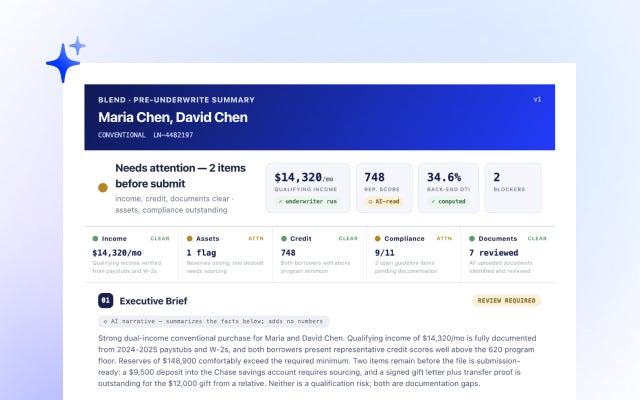
Autopilot Update: Meet the First Wave of Customers
The first wave spans the full lending landscape. See what Autopilot's first commercial wave signals for the industry.
Read the article about Autopilot Update: Meet the First Wave of Customers
Autopilot Enters Its Next Chapter
16 weeks. 25,500 loans. See what early adopters helped Autopilot become.
Read the article about Autopilot Enters Its Next Chapter