
August 26, 2026 in Blend momentum
Autopilot Update: A Preview of Navigator
Autopilot has always shown its work. This update will let loan officers act on it directly, one approval at a time.

Our Autopilot roadmap is organized around three priorities: make the agent more dependable, give lenders more control, and open the platform to new AI-powered workflows. Navigator puts that third priority into practice as a productivity tool for loan officers, and it will be coming to beta soon.

Navigator is designed to help loan officers work more efficiently by finding answers in a specific loan, understanding what Autopilot has already reviewed, and directing the next step without searching through the file or leaving the loan workflow. A loan officer will be able to ask about the loan in plain language and get an answer grounded in what Autopilot has already reviewed. They will also be able to go a step further by telling Autopilot to make a change to the loan. The agent will carry it out once the loan officer approves.
That is the direction this work is taking: bringing questions and actions into the same workflow while keeping the loan officer in control of anything that changes the file.
Let’s look at what we’re building toward.
Navigator: a productivity tool for loan officers
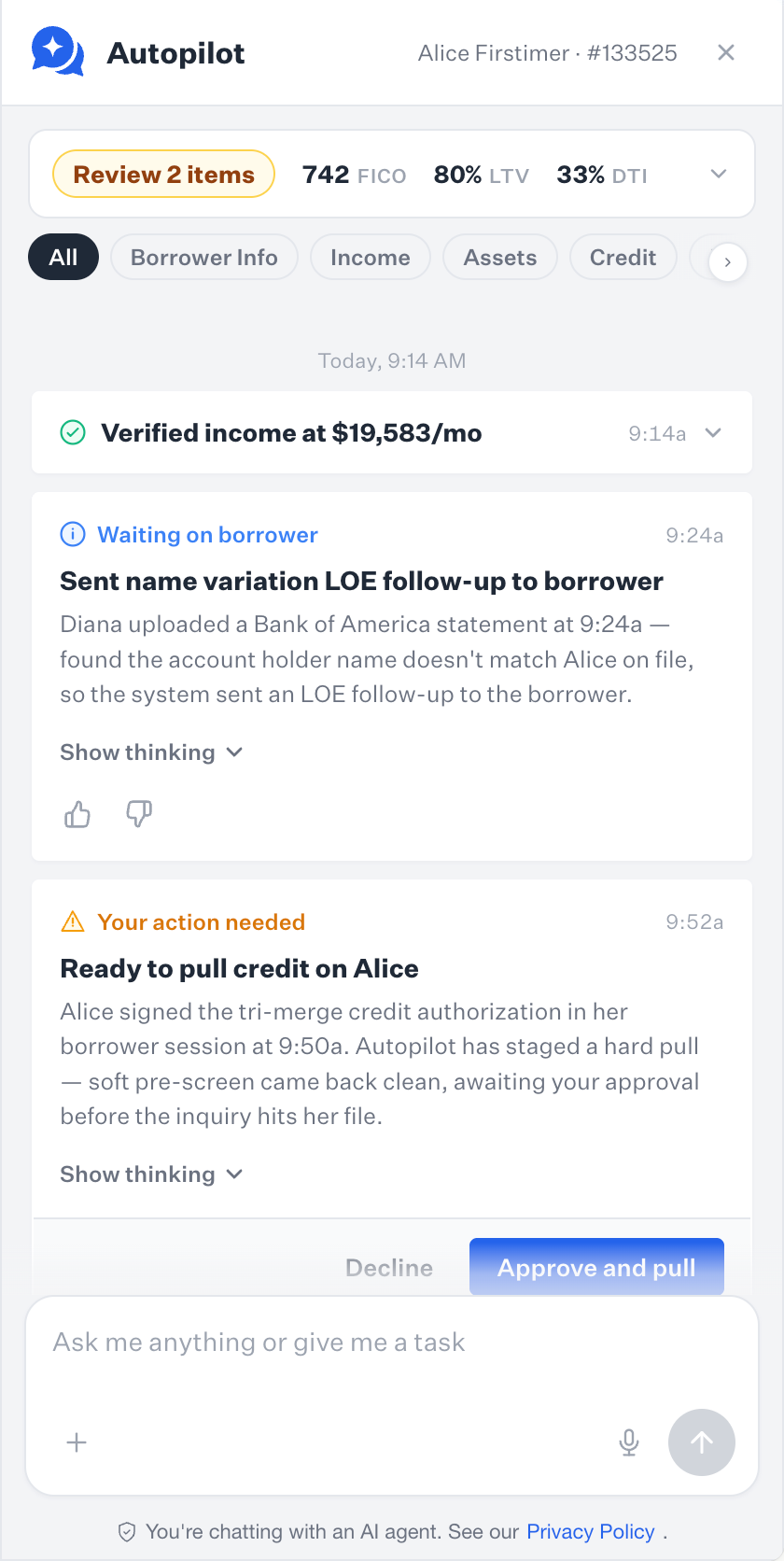
AuNavigator will be a conversation with the agent about a specific loan, right in the loan file. It will follow a simple, deliberate split: Reads are immediate; changes require approval.
A loan officer will be able to ask the questions they would otherwise have to answer by searching through the file:
- “What’s the qualifying income on this loan, and how did you get there?”
- “What documents are still outstanding, and who owes them?”
- “Why did you ask the borrower for a letter of explanation?”
- “What’s the DTI, and did it change after the credit pull?”
Because the answer will come from Autopilot’s already reviewed findings and the loan record, the loan officer will be able to trace it back to its source. Where the agent has not reviewed something, it says so instead of inventing an answer.
Direct the work with approval
Navigator will also be able to do the work, not just describe it. Ask it to update a field, correct a borrower’s name, reassign the loan, send a request, or advance a milestone. Rather than acting immediately, it will present the proposed change as an approval card.
Nothing will happen to the loan until the loan officer approves the change and completes the required consent and authorization steps. The loan officer will make the decision; the agent will carry out the approved change.
That boundary is the point. Every action Autopilot can take on a loan through Navigator will be gated behind the loan officer’s explicit approval, while questions will remain available within the user’s existing permissions. A loan officer will be able to move quickly on the things that only need an answer and stay firmly in control of the things that change the file.
Subscribe to Autopilot updates
The same guardrails apply
Two guardrails will support that boundary:
- It answers and acts from actual data, not assumptions. Navigator will be grounded in Autopilot’s findings and the loan record, with the same source traceability the pre-underwriting summary provides.
- It respects the same permissions the rest of the file does. A user will be able to access through Navigator only what they are already entitled to see and do on the loan. The conversation will not create a separate path around the file’s access controls.
When it becomes available, Navigator will be lender-controlled and enabled per lender, in the same place as other Autopilot capabilities. No separate deployment or integration work will be required.
Built on the foundation lenders are already extending
Navigator is built on the same platform layer that lenders are already using to build their own agents and workflows on top of Blend. That matters because Navigator is not a one-off feature. It brings that foundation into a lender-facing workflow and works the way lender-built experiences should work: grounded in actual loan data, aware of permissions, and traceable to source, with reads available and changes gated behind human approval.
A lender that wants to build something of its own is building on the exact same layer, with the same controls.
Improving borrower chat reliability
Our last update introduced automatic retention of borrower chat: after a quiet period, the conversation is filed to the loan as a PDF before the underlying messages are purged. We said then that we were working toward a single transcript covering the life of the loan. This period, that shipped.
Instead of separate documents for each conversation window, loan teams can now get one document that assembles the full conversation from the filed parts.
We also closed a real gap underneath it: borrower chat previously had no alerting, and a production outage could go undetected far too long. It is now monitored, so a failure surfaces immediately instead of hiding behind an otherwise healthy-looking system.
Under the hood
As always, much of the work this period is not visible in a workflow. It went into making the agent better where it already operates.
- A pre-underwriting summary that fails honestly: The summary no longer invents a reserve requirement when none is documented or gets stuck when a figure appears more than once. Section-level failures are now attributed and measured per section, so a broken section is visible instead of silently blank.
- More resilient model calls: Autopilot no longer drops a supervisor event when the model provider returns a temporary server error while the workflow reports success. A transport issue that could fail some concurrent calls has also been fixed, reducing the chance that a review stalls because of a temporary upstream failure.
- Sharper income evaluations: The income pipeline’s evaluators now grade the request and the calculation, not just the final write-back, so a wrong step is caught even when the end value happens to look right.
Navigator will give lenders a new way to put Autopilot’s verified work to use. A loan officer will be able to ask about the file without searching through it, then approve a change without leaving Navigator.
They will be able to ask a question and get an answer grounded in what Autopilot has reviewed. When something needs to change, they will approve it and the agent will carry it out after the required checks are complete.
That is the throughline in everything we have shipped since launch. Autopilot does the work, shows how it reached each figure, and keeps the person responsible in control of anything that alters the file. Navigator extends that approach into a new productivity workflow: not a new place for the agent to act on its own, but a new way for the people who own the loan to direct it.
To get started with Blend Autopilot, contact your Blend account team.
We publish a new update every two weeks. Subscribe to Autopilot updates to stay current with everything we’re shipping.
Find out what we're up to!
Subscribe to get Blend news, customer stories, events, and industry insights.
Autopilot Update: The Early Results Are In. Now We’re Making Them Repeatable.
45,000 loans in. See what it took to make Autopilot's early production numbers hold up.
Read the article about Autopilot Update: The Early Results Are In. Now We’re Making Them Repeatable.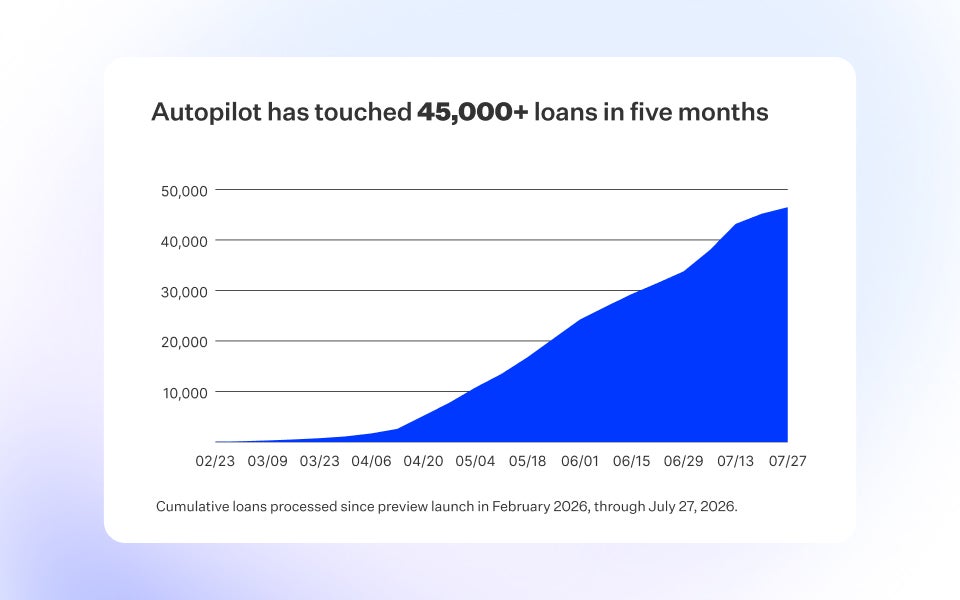
Autopilot Update: A Pre-Underwriting Summary That Shows Its Work, and Sharper Income and Asset Judgment
Every figure, every source. See how Autopilot's latest update makes pre-underwriting faster to act on.
Read the article about Autopilot Update: A Pre-Underwriting Summary That Shows Its Work, and Sharper Income and Asset Judgment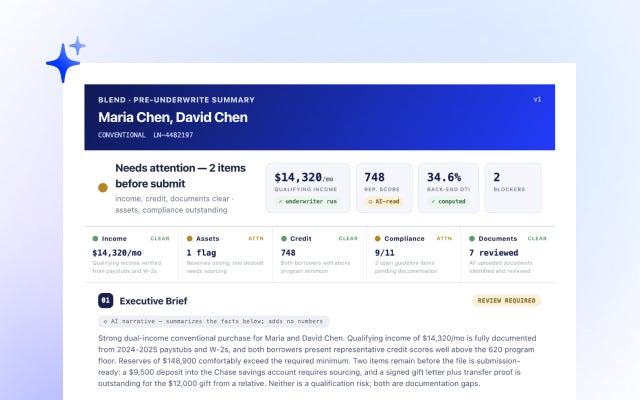
Autopilot Update: Meet the First Wave of Customers
The first wave spans the full lending landscape. See what Autopilot's first commercial wave signals for the industry.
Read the article about Autopilot Update: Meet the First Wave of Customers