August 10, 2026 in Thought leadership
How Agentic AI Can Transform Mortgage Fulfillment and Cut Cost per Loan
Agentic AI doesn't just automate tasks. It orchestrates the entire loan fulfillment workflow, and the cost savings are measurable.

In a recent post, we made the case that the mortgage industry’s defining competitive challenge right now isn’t rate. It’s cost per loan. With per-loan production expenses exceeding $12,500 and the market projected to stay relatively flat at $2.2 trillion in 2026, lenders can’t expense-manage their way to profitability. The answer is rebuilding the loan production workflow itself.
The technology to do that exists today. It’s called agentic AI, and it’s categorically different from anything lenders have deployed before.

What agentic AI means for mortgage lenders
The word “AI” gets used loosely across the mortgage industry. Chatbots that answer borrower questions, systems that extract data from documents, models that score credit risk. These are all useful tools. But they’re reactive. They respond when prompted. They assist when asked.
Agentic AI is different in a fundamental way. Rather than waiting for a human to route a task, an AI agent can autonomously execute multi-step workflows, coordinate between systems, handle exceptions in real time, and loop back when something needs attention, without a human managing every transition.
Think of it as the difference between an assistant who waits to be told what to do and a specialist who understands the goal, figures out the path, and gets it done.
In mortgage fulfillment, this distinction matters enormously, because the cost problem in mortgage isn’t concentrated in any single step. It’s distributed across every handoff in the process.
Where mortgage origination costs are actually accumulating
Despite decades of digitization investment, industry data suggests the average mortgage still takes 38 to 42 days to close, nearly unchanged from several years ago. The reason is that most lenders have automated individual tasks within a workflow that remains fundamentally disconnected.
Those costs concentrate in five specific areas:
Application intake. The Uniform Residential Loan Application contains 236 fields. It’s the single greatest source of borrower friction and data error in the origination process. Every mistake at this stage cascades forward, creating rework in processing, exceptions in underwriting, and delays at closing.
Document processing. Borrowers submit pay stubs, W-2s, bank statements, and property documents through a dozen different channels in a dozen different formats. Processing teams spend significant time classifying, validating, and chasing missing items, work that currently takes hours and days rather than minutes.
Underwriting. Even with automated underwriting systems like Fannie Mae’s Desktop Underwriter and Freddie Mac’s Loan Product Advisor, underwriters spend substantial time on exception handling, data reconciliation, and manual risk assessment. This is where capacity constraints create the longest delays.
Compliance and QC. Regulatory requirements add another layer of manual review, particularly as state and federal rules evolve. Historically, post-close QC has sampled only a fraction of loans, leaving significant portions of the portfolio unreviewed and unprotected.
Borrower communication. Delays in borrower communication are a leading cause of application abandonment. When borrowers don’t know what’s needed or what’s happening, applications stall, and stalled applications cost money.
Agentic AI addresses all of these systematically, not as isolated automations but as an interconnected workflow transformation.
How agentic AI transforms each phase
From 236 fields to a conversation
Instead of presenting borrowers with a dense application form, an agentic AI concierge guides them through plain-language questions, gathering income details, property information, and financial data conversationally. The system cross-references answers against historical patterns, flags inconsistencies, and automatically populates the correct application fields in real time.
By the time a borrower reviews and submits their application, most fields are already verified and pre-filled. Intake time compresses from days to hours, and errors that would have created downstream rework are caught before they enter the pipeline.
From document queues to immediate clearance
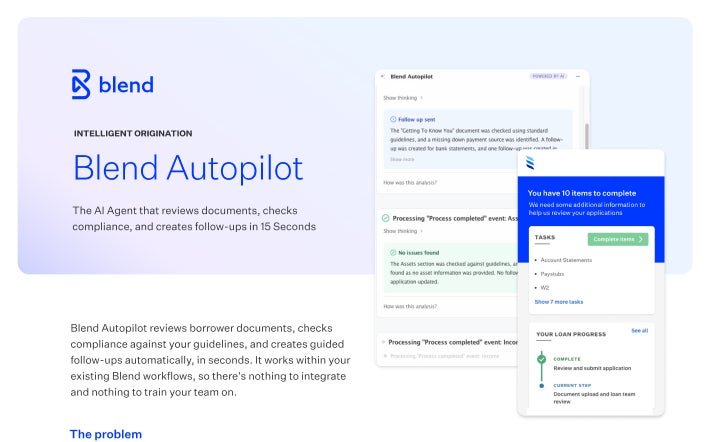
Rather than routing uploaded documents to processing queues that clear over the course of a workday, a document agent can classify each file, extract relevant data, validate entries against borrower inputs, and identify what’s missing, all within minutes of upload.
If documentation is incomplete, the system doesn’t wait for the borrower to log back in. It reaches out autonomously with targeted requests for exactly what’s missing. No generic “please provide additional documents” friction. Proactive reminders are sent at appropriate intervals based on borrower type and communication preferences.
Augmenting the underwriter, not replacing them
Agentic AI doesn’t replace Fannie Mae’s DU or Freddie Mac’s LPA. It acts as connective tissue between those systems, the loan origination platform, and the human underwriter, automating document collection, pre-validating borrower inputs, and triaging exceptions before they reach the underwriter’s desk.
The underwriter receives a file that’s already been organized, validated, and flagged for the specific issues that require human judgment. The work that remains is genuinely high-value: complex risk analysis, nuanced borrower circumstances, and exceptions that require expertise. The work that was previously consuming the most time, data reconciliation and document chasing, is handled upstream.
According to Freddie Mac’s updated Cost to Originate analysis, lenders who extensively use AI-enabled digital capabilities experience approximately 40% fewer loan defects compared to those with low usage. Fewer defects mean fewer repurchases, fewer post-close audits, and better investor relationships.
Compliance: real-time regulatory intelligence
As AI compliance capabilities mature, a compliance agent can monitor each file against current CFPB and investor requirements, adapting when new bulletins drop. Rather than catching compliance exceptions at post-close review, the agent flags issues in real time during the origination process, when they’re far cheaper to resolve.
Post-close QC that once required sampling 10% of loans can shift to reviewing 100% automatically, dramatically reducing repurchase exposure and audit preparation time.
The pull-through multiplier
One of the least visible but most impactful applications of agentic AI is borrower communication. An AI messenger agent provides borrowers with clear, plain-language updates and next steps throughout the process, without requiring additional call center headcount.
The downstream impact is meaningful. Borrowers who understand what’s happening and what’s needed move faster. Abandoned applications decline. Pull-through rates improve. According to Freddie Mac’s updated Cost to Originate analysis, better pull-through rates alone can generate millions of dollars in incremental annual revenue for mid-size lenders, before any cost reduction is factored in.
Scaling agentic AI across the mortgage lifecycle
The industry has no shortage of AI pilots. The challenge is moving from a contained proof-of-concept to a deployment that transforms operational economics at scale.
The lenders making that transition successfully share a few characteristics. First, they’re defining clear, measurable goals, not just “improve efficiency” but specific targets for cost per loan, cycle time, and defect rates. Second, they’re identifying use cases that are cross-functional by design, so agents built once can be deployed across multiple departments and stages of the loan lifecycle. Third, they’re building AI into integrated workflows rather than as point solutions layered on top of existing fragmentation.
The technology architecture matters here. Agentic AI that can’t communicate across the LOS, third-party data providers, compliance systems, and borrower interfaces isn’t agentic in any meaningful sense. It’s just another silo. The lenders seeing the greatest operational impact are those deploying AI as an enterprise orchestration layer, not a departmental add-on.
The cost-per-loan gap that’s reshaping mortgage competition
The math is clear. According to Freddie Mac’s 2024 Cost to Originate Study, the top 25% of lenders produce loans at $6,900 each. MBA’s Q1 2025 performance data puts the industry average above $12,000. The gap between those two numbers, roughly $5,000 per loan, is what separates businesses that are structurally viable from those that are perpetually chasing volume to cover overhead.
A lender closing 5,000 loans per year at $12,000 per loan spends $60 million in production expenses. The same lender at $7,500 per loan spends $37.5 million, freeing $22.5 million annually to reinvest in growth, lower rates for borrowers, or return to shareholders.
That’s not a marginal improvement. That’s a fundamentally different business.
Why lenders who act now will lead the next rate cycle
Lenders who invest in agentic AI now, when market conditions create the space for implementation and training and before the next rate cycle compresses timelines, will be positioned to capture volume efficiently when it returns.
Those who wait for volume to justify the investment may find the investment is no longer available to them on their own terms.
The mortgage market has always rewarded the operators who build better. In 2026, building better means building with agentic AI.

See how Blend’s AI capabilities can help you reduce cost per loan and modernize mortgage fulfillment.
Find out what we're up to!
Subscribe to get Blend news, customer stories, events, and industry insights.
Competing in a Flat $2.2 Trillion Market by Fixing Cost per Loan
The mortgage market is projected to reach $2.2 trillion in 2026, but flat isn't the same as easy. With per-loan costs exceeding $12,500, discover why cost per loan is the…
Read the article about Competing in a Flat $2.2 Trillion Market by Fixing Cost per Loan
The Intelligent Lending Playbook
How AI agents are redefining mortgage origination. From borrower experience to loan officer productivity.
Start learning about The Intelligent Lending Playbook
Blend Autopilot: AI That Keeps Loans Moving Forward
The AI Agent that reviews documents, checks compliance, and created follow-ups in 15 seconds.
Start learning about Blend Autopilot: AI That Keeps Loans Moving Forward