
November 23, 2026 in Mortgage Suite
Mortgage Pre-Approval Is Becoming a Digital Experience, Not Just a Document
Pre-approval can be the start of a more connected path to closing.


For many lenders, the pre-approval experience is a critical moment when borrowers decide whether to move forward with the lender. It is also where a loan officer begins to spend time and where the real estate agent starts to assess whether an offer can move forward.
The letter matters, but the workflow behind it matters more. If a lender asks for the same information twice, waits on manual checks, or sends the borrower through disconnected steps, a faster first answer will not solve the problem.
That’s driving demand for mortgage pre-approval and prequalification software that carries borrower information into the next steps of the lending process, rather than stopping at the letter. Lenders that get this right can respond earlier, support loan officers at the moment of intent, and carry more momentum into the application and closing process.
Pre-approval is a starting point, not a finish line
A self-serve pre-approval creates real value when it does more than give a borrower an early answer. The information captured at the start should carry into verification, underwriting, pricing, communication, and the full application. Otherwise, the lender has digitized an entry point without improving the journey.
When that information does not carry forward, the borrower receives an answer but still encounters the same requests and handoffs that made the process difficult in the first place. The loan officer receives a new lead but still has to rebuild the context behind it.
The better approach is to treat pre-approval as the first stage of origination. The process should produce a decision the lender can act on and the borrower can use to move forward.
What a modern mortgage pre-approval experience needs
The difference shows up in what happens after the borrower begins. Three capabilities determine whether self-service improves the process or simply moves the first step online.
1. Make it easy to start, then preserve context
Borrowers do not begin their home search only during business hours. They may be comparing neighborhoods after work, speaking with a real estate agent over the weekend, or exploring affordability before they are ready for a conversation with a loan officer.
A streamlined pre-approval process lets borrowers start when they are ready and carries the information they provide into the lender’s workflow. That gives loan officers useful context from the beginning instead of another lead to reconstruct.
The value of self-service is not that it removes the lending team. It extends the team’s reach. Borrowers can start on their own schedule, while loan officers spend more time guiding and advising borrowers.
2. Use current data to make the answer more useful
An instant answer is not necessarily a useful answer. It needs to be based on information the lender can trust, the policies the lender has configured, and a process that makes the next step clear.
A stronger approach is not a standalone eligibility page. It is a data-prefilled point-of-sale workflow embedded in the lender’s existing systems, so information captured at the start carries into the rest of the origination process.
A modern mortgage prequalification workflow may combine data prefilling, soft credit pulls, connected account data, automated asset validation, pricing, and connections to automated underwriting systems. Together, these capabilities can support pre-approved lending based on real-time account data while reducing avoidable requests later in the process.
The goal is to automate data collection and repeatable checks so loan officers can focus on affordability questions, changing scenarios, exceptions, and borrower guidance. The borrower gets a clear answer while the lender retains control over how that answer is reached and when additional review is required.
3. Keep the transaction moving after the decision
Pre-approval is a shared moment in the homebuying process. The borrower needs access to the result and a clear understanding of what to do next. The loan officer needs the application context to advise the borrower and move the file forward. Once the borrower is ready to make an offer, the real estate agent needs accurate information from the lender to support the transaction.
Each participant needs the right level of access. Borrowers need their pre-approval information. Loan officers need to manage the relationship and share the appropriate approval letter or status update with the agent. The lender controls what is shared and when.
That coordination matters once the borrower starts shopping. A pre-approval that remains useful from initial interest through home search and offer creates more than a faster document. It creates a stronger handoff into the transaction.
The operational case for a better pre-approval workflow
The same changes that reduce borrower friction can also reduce avoidable work for the lending team.
Every repeated data entry request, manual verification, and unclear handoff creates work somewhere in the process. At scale, that work limits how many borrowers a team can support and how quickly loan officers can respond to new opportunities.
“By offering the ability for our members to obtain a pre-approval online, we are able to provide an answer immediately and give our members peace of mind that they are well qualified to buy the home of their dreams, all while increasing the efficiency of our team.”
Chief Credit Officer, University of Wisconsin Credit Union
A better workflow gives loan officers more time to guide and advise borrowers. Operations teams can focus on exceptions and complex files instead of correcting missing information or rebuilding applications.
Automation should reduce work, not judgment
Without automation, a loan officer spends hours organizing documents, tracking down missing information, and calculating income before they can assess a borrower’s options.
With AI handling that groundwork, the loan officer can focus on reviewing exceptions, explaining options, and determining next steps. To apply their judgment, they need to see where each answer comes from and what still needs review.
Automation reduces the work required to make an informed decision. The loan officer still makes the judgment calls.
That distinction matters as lenders plan their next investment. The goal with AI is not to remove the loan officer from the process, it’s to give them more time back to build the relationship and apply judgment where it matters.
What lenders should ask when evaluating a digital origination solution
The right evaluation goes beyond the application page and the speed of the initial response. It looks at what happens after the borrower clicks submit.
- Does prequalification data carry into the full application? Information captured at the start should flow into verification and the application, so borrowers and loan officers are not repeating the same work.
- Can lenders configure the workflow to match their policies? Look for flexibility across data prefilling, soft credit, connected account and asset data, pricing, and automated underwriting.
- Does verification reduce follow-up requests? A faster answer is more valuable when it is based on current, reliable information that reduces avoidable requests later.
- Can loan officers see the context behind the result? They should be able to understand the application, step in when needed, and continue the process without rebuilding the borrower’s file.
- Can lenders control what is shared with real estate agents and other transaction participants? The workflow should support timely information sharing while keeping the lender in control of the relationship.
- Does automation reduce repetitive work while preserving human judgment? The goal is to automate data collection and repeatable checks while leaving room for loan officer guidance and judgment.
- Can the workflow carry the borrower into the broader origination process? Pre-approval should be a starting point for origination, not a disconnected endpoint.
The strongest solution will not win on feature count alone. It will show how the workflow fits the lender’s policies, compliance requirements, borrower experience, loan officer workflow, and plans to grow volume without adding avoidable manual work.
How Blend helps lenders put this model into practice
Blend’s Home Lending Suite connects mortgage origination, verification, lender tools, and closing in one workflow. Depending on configuration, Blend Mortgage Originations can support self-service applications, soft credit prequalification, data prefilling, verification, pre-approval letters, and configurable lending workflows.
Blend Lender Tools helps loan officers manage work and stay connected to borrowers throughout the process. Blend Autopilot supports repeatable pre-underwriting and follow-up tasks while keeping the lender in control of decisions and borrower relationships.
The point is not to add technology around the pre-approval letter. It is to make the letter the visible output of a process that helps borrowers act, helps loan officers advise, and helps lenders carry momentum into the next stage of origination.
Make every pre-approval a step toward closing
A pre-approval should do more than confirm eligibility. It should give borrowers a clear next step, give loan officers the context to advise, and give transaction partners the information they need to keep the process moving.

Ready to help borrowers act sooner while giving loan officers more time for the work that moves loans forward?
Find out what we're up to!
Subscribe to get Blend news, customer stories, events, and industry insights.
The AI-Powered Pipeline: How Conversational Workflows Drive Higher Pull-Through and Faster Closings
A look at how Autopilot and Navigator work mortgage files before your team even logs in.
Watch video about The AI-Powered Pipeline: How Conversational Workflows Drive Higher Pull-Through and Faster Closings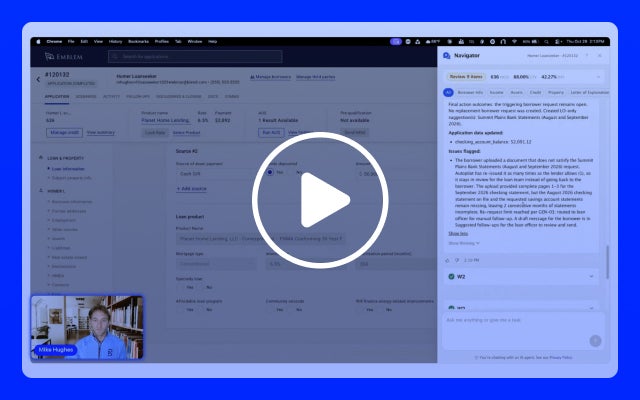
Autopilot Update: Navigator Takes on More of the Loan File
Add gifts, liabilities, and agents by asking, work through an income drop, and see who acts next.
Read the article about Autopilot Update: Navigator Takes on More of the Loan File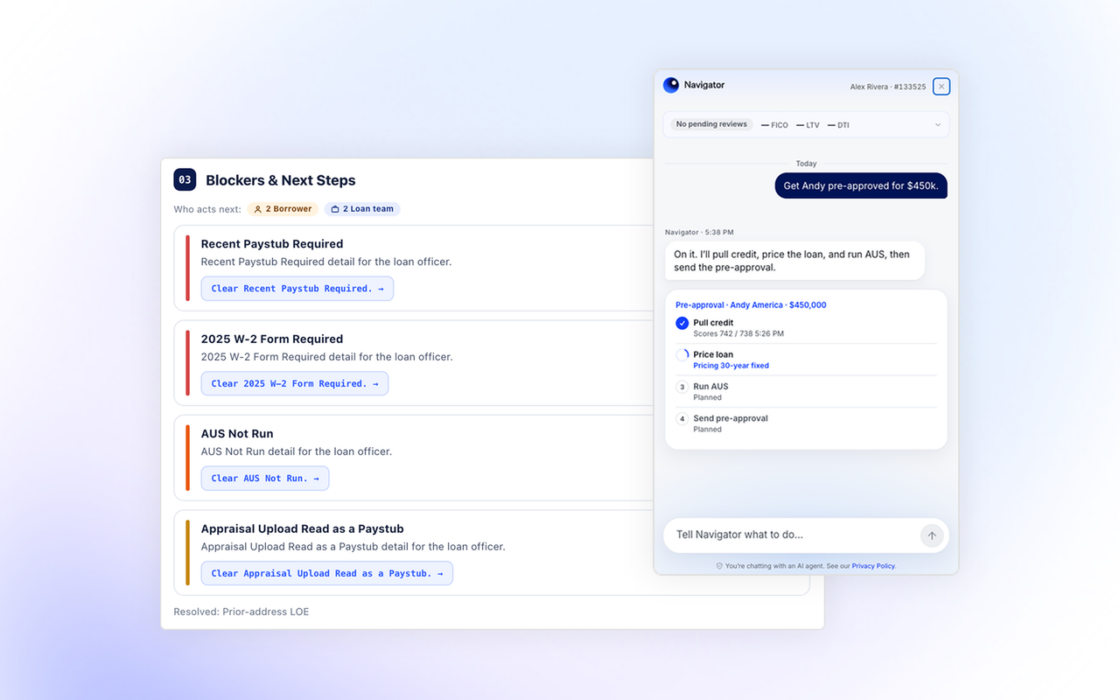
The AI-Powered Pipeline: How Conversational Workflows Drive Higher Pull-Through and Faster Closings
A look at how Autopilot and Navigator work mortgage files before your team even logs in.
Watch video about The AI-Powered Pipeline: How Conversational Workflows Drive Higher Pull-Through and Faster Closings