
November 9, 2026 in Mortgage Suite
What a Five-Day Home Equity Close Requires
The lenders hitting five-day closes aren't out-innovating fintech. They're rethinking how files move through the queue.

Faster home equity closes start with sorting files by complexity, so a simple file never waits behind a complicated one.
Leadership tells lending teams to be more like a fintech, but that mandate rarely comes with a real definition. Sometimes it means a faster digital experience. Sometimes it means fewer clicks. It always arrives with the same headcount and the same list of competing priorities attached.
Five days has become the number most lending teams are chasing. Not because it’s a fixed formula, but because it’s the point where speed stops being a differentiator and starts being table stakes.
Getting there starts with a less glamorous change: sorting straightforward files from complicated ones so they no longer wait in the same line.

Why customers are leaving for fintech when the rates barely differ
Home equity borrowers aren’t rate-shopping the way mortgage borrowers do. Most institutions land within a hair of each other on pricing right now, and a small rate difference doesn’t move someone who needs $50,000 for a roof repair this week.
Home equity borrowers start with a problem, and the fastest, least painful path to solving it wins. That reframes what actually competes for the customer’s attention. The deciding factor is which lender gets back to them first with a clear answer, and the basis-point spread between two offers carries far less weight.
Slow closings trace back to process nobody’s rechecked in years
The instinct is to treat a slow close as a technology gap: buy the tool, get the fintech speed. But the drag most institutions are fighting didn’t come from a missing system. It came from process decisions made years ago and never revisited since.
The clearest place this shows up is in how files get routed once they’re submitted.
At Blend Forum, one lending leader pointed to full appraisals ordered on every file regardless of actual risk, “not because it’s what we should do or they’re high risk. It’s just because that’s what we’ve always done.” Document requirements added long before anyone in the current role could explain why.
Each of these is an old process built around limitations that no longer exist.
A simple file shouldn’t wait behind a complicated one
Most institutions still run every application through one standard queue, the ready-to-close file sitting next to the one that actually needs a second look. That means a straightforward application can lose real time simply waiting for someone to look at it, not because anything is wrong with it, but because it’s stuck behind loans that genuinely require the extra scrutiny.
The session described this pattern in concrete terms: a file gets marked good to go, and instead of moving, it sits “stuck behind 37 other loans.” By the time a loan officer reviews it, the file is fine, and they “just lost 10 days because it was sitting in this queue waiting for them to put their eyes on it.”
Instead, each file should move into the queue built for its level of complexity: one for files that need more scrutiny, and one for files that don’t need much review. Both still get reviewed, but at the pace their complexity actually calls for.
It requires tracking cycle time by the day, not the quarter
A queue problem like this stays invisible if cycle time is only reviewed monthly or quarterly. By the time it surfaces in a report, the delay has already cost real days, and there’s no way to tell whether it’s a structural issue or a one-off, someone out, someone covering an unfamiliar queue.
The session raised exactly this gap: reporting tools tracking service-level agreements “like the monthly or the quarterly level. By that point, it’s too late.” Reviewing where files actually sit, stage by stage, on something closer to a daily cadence is what catches a stuck file while there’s still time to move it, not after the fact, when the only thing left to do is explain it.
It requires shared deadlines, not departmental handoffs
Even a well-designed queue breaks down if each team is only accountable to its own service-level agreement. When underwriting, operations, and closing each treat their piece as finished the moment they hand it off, no one owns the total time the customer actually experiences.
The session pointed to exactly this pattern as a source of delay: separate teams working to their own deadlines rather than one shared standard for the file as a whole. Setting one deadline for the full process, rather than a separate one per department, is what makes prioritizing simple files actually hold. It turns “not my part anymore” into “not done until the customer is done.”
Where the harder gains come from
The fixes above get most institutions most of the way there. Getting to five days consistently, rather than on the files that were already easy, tends to mean extending the same logic further, in two directions in particular.
Institutions further along this path typically apply the same principle to the data itself. If a customer already has a mortgage or deposit account on file, the application shouldn’t re-ask for information the institution already holds. That’s a harder engineering lift than reordering a queue, but it compounds the same idea: don’t make a simple case work as hard as a complicated one.
The other lever is decisioning speed at the point of application, not just processing speed after submission. A file that gets an early read on eligibility, before it enters any queue at all, removes days that no amount of internal reprioritization can recover once the file is already in the system.
Neither of these is a small project. Both extend what’s already at work above: speed comes from removing unnecessary steps, not adding new ones. The queue and SLA fixes are where most institutions can start. Prefill and early decisioning are where the harder, longer-term work goes next.
It requires using the trust fintech doesn’t have
Fintech lenders have grown quickly in home equity, largely by being fast and easy to reach. But their biggest weakness is structural. They’re rarely the customer’s first call when something goes wrong. A bank or credit union with existing account history and a nearby branch starts every conversation with something a fintech has to build from scratch.
As the session put it, a customer with an issue at a fintech has nowhere obvious to go. A customer with an issue at a bank “can walk out your neighborhood and probably find a branch within, I would say, within a 5 to 10 mile radius.” That head start only pays off if it’s used before the moment of need becomes a search elsewhere.
The question is how many files you’re still treating the same way
Five days is what’s left once files stop waiting behind ones they don’t belong next to. For any lending team chasing fintech speed, a good test is whether their queue can tell the difference between a file that’s ready and one that isn’t.

Want to see how Blend’s Rapid Home Equity helps lenders move toward a five-day home equity close?
Find out what we're up to!
Subscribe to get Blend news, customer stories, events, and industry insights.
Autopilot Update: Easier Fee Updates and Clearer AUS Checks in Navigator
Close-match fee lookups and required-field checks that catch gaps before AUS submission.
Read the article about Autopilot Update: Easier Fee Updates and Clearer AUS Checks in Navigator
Autopilot Update: More Control Over Borrower Requests and Expanded Review Checks
Fewer repeat asks for borrowers and fewer missing-document surprises at underwriting.
Read the article about Autopilot Update: More Control Over Borrower Requests and Expanded Review Checks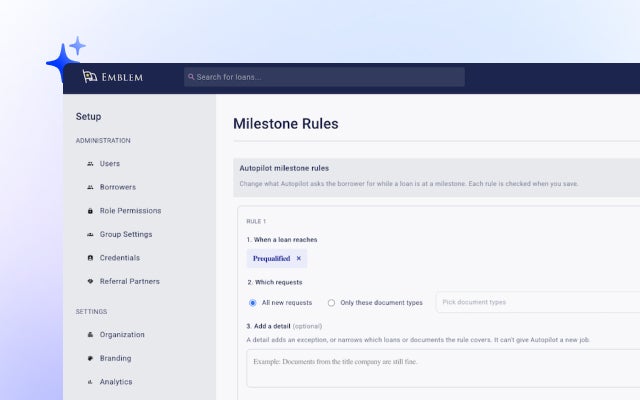
Navigator Mobile Is Now in Beta: Your Pipeline, in Your Pocket
Five minutes between appointments is now enough to know which files need you.
Read the article about Navigator Mobile Is Now in Beta: Your Pipeline, in Your Pocket