September 2, 2026 in Blend momentum
Unbound: Five Takeaways from Blend Forum 2026
Five ideas from Forum 2026 on how AI can expand capacity, strengthen relationships, and reshape the lending experience.

Nima Ghamsari took the stage twice at Blend Forum, our annual gathering of lending leaders, held in Austin last week. First for Elevate, Forum’s executive track, in a session with a room of lending executives, then for the afternoon keynote, Unbound. Across both conversations, he returned to one question: what changes when lenders are no longer limited by the capacity of their teams or the forms that organize their work?

For years, lending has been bound by the capacity of its teams, processes that bury people in manual work, and an application form that has too often stood in for the customer experience. At Forum 2026, speakers examined what happens when those constraints begin to loosen.
Five takeaways emerged, spanning capacity, employee roles, relationships, AI governance, and the application experience.
1. Banking never had a technology problem, it had a capacity problem
Blend started in 2012 with a single idea: a mortgage that could drive itself. The obstacle was never a lack of ambition. A mortgage brings together thousands of pages of rules and each borrower’s unique financial situation. For years, lenders have added workflow tools, integrations, and portals to manage that complexity, but people still had to step in whenever a file reached an exception.
What changed this year is that an agent can be deployed alongside a loan and actually work it.
The agent has the full context: the rules, the borrower’s situation, everything that has happened on the file. What Nima described as “an infinitely scalable workforce that lives alongside your humans,” with your humans running it. Your team can oversee a hundred times what it could before.
The part executives kept returning to was what that does to capacity planning. Volume has always meant headcount, and headcount has always been hired against a forecast that’s wrong by the time it clears. If the work itself scales, that math breaks.
2. People move up, not out
The fear about AI in lending is that it replaces the loan officer. The argument is the opposite. What goes away is the work nobody became a banker to do: chasing documents, re-keying data, running status checks. What stays, and grows, is judgment on complex files, negotiation, and the nervous first-time borrower at eleven at night who needs a person. That work is more valuable, not less.
The routine gets handled in an ambient way and the exceptions get pushed to someone “playing air traffic control.”
The human does not disappear from this model. Teams can let the agent work in the background, then step in when a borrower needs judgment, explanation, or reassurance.
That framing sets a real bar for the technology. Air traffic control only works if the controller can see what’s happening, which means an agent that acts on a file has to show its work: what it calculated, how it got there, and what it changed. An agent whose reasoning is invisible doesn’t free anyone up. It moves the anxiety somewhere else.
3. The return of relationship banking
Community banking was originally a relationship: a banker who knew you, your situation, and what you were trying to build. That didn’t die because bankers stopped caring. The process buried them.
The demand for timely, relevant financial guidance never went away. What disappeared was the capacity to deliver it. So when AI takes the process back, there’s a real decision about the hours.
Both are legitimate. Plenty of institutions will book the savings. The more interesting answer is to put the time back into the customer, and eventually to get ahead of them entirely, reaching out before they ask, to the homeowner who is HELOC-ready or the business that will need a line of credit in ninety days. Proactive, relational finance. That could make 100,000 customers feel known with the same personal context a banker once had for 100.
Putting that time back into the customer can create a more continuous experience: an offer shaped by the customer’s situation, followed by a process that remembers what they have already shared and responds to what comes next.
Same institution either way. The only difference is what you did with the hours.
4. The moat isn’t the model, it’s the harness
Every institution now has access to the same frontier models. So the models aren’t the differentiator. The harness around them is.
None of that is a single event. It’s a thousand specific ones: whether an unreadable document stops for a resend or gets passed downstream for the agent to guess at; whether the agency guidelines the agent reviews are the ones published this week or the ones loaded last quarter; whether a line item on a paystub is the borrower’s income or the employer’s benefit payment.
An agent that acts on a file must make its work visible as the file changes. It should update outstanding conditions as new documents and third-party data arrive, show the work behind its calculations, and give the team a current view of what has been reviewed and what remains.
Which gives lenders a sharper question to ask any AI partner, Blend included. Not “can it complete the task?” Most things can, on a good file. Ask what governs it when it acts on your behalf.
3. The return of relationship banking
The application was never the product. It was a data-collection ritual. When an agent can assemble the file in the background, the 45-minute form becomes a one-tap confirmation. The point of sale doesn’t get better. It gets thinner until it’s optional. In the years ahead, a mortgage might start in your mobile app, in a realtor’s CRM, or in the customer’s own AI assistant, with no application screen at all.
For a decade the industry bought and compared front doors: whose experience was smoothest, whose UI was prettiest. “In a headless world, nobody sees the door.” The competition moves behind it, to whose systems an agent can work with most easily and safely, and whose inference can be trusted to execute as intended.
Then it goes one step further. Customers will bring their own agents: my person wants a mortgage, here’s their financial picture, what can you do? Handled machine to machine over open standards like MCP. The winners won’t be the most automated. They’ll be the most personal.
How you actually get there
The recipe Nima gave the room was two words: focus and small teams.
That focus was paired with close collaboration. Customer feedback helped move the idea from quality control at the back of the process to intelligence at the front, while lender teams helped identify and address the frictions that remained.
More than 65 lenders have turned on Autopilot. The early performance signals are preliminary, based on cohorts measured against their own baselines. They point to a direction, not yet a conclusion. And Autopilot does not make lending decisions.
The decade ahead
The case for not waiting is that the 2030s may bring substantial housing demand, small business formation, and demand for credit. Institutions that enter that decade with bankers facing customers instead of paperwork will be better positioned to grow. Those still staffing the process will be carrying a higher cost structure.
Nima left the room with five questions rather than a pitch, and they’re the most useful thing to take back to your own team:
- Have you piloted an agent that completes tasks, not just assists?
- When agents work the file, what does your LO actually do all day, and has compensation changed to match?
- Who owns AI at your institution: IT, ops, or the line of business?
- Would the hours you win back go to relationships or straight to cost savings?
- If the application stops being the differentiator, what replaces it?
What it all adds up to
Unbound is not a claim about automation. It’s a claim about what happens to an industry when the things that held it in place stop holding: the capacity ceiling, the process, the front door everyone spent a decade decorating. None of that is decided by the models, which everyone will have. It’s decided by the harness around them and by what each institution does with the hours that come back.
Which is why the least glamorous idea of the day is the one that matters most. What comes unbound has to be governed. The institutions that get that right are the ones that will be free to move and, as Nima closed, free to give their people the customer back.

See how Blend Autopilot can help your team expand capacity and spend more time with customers.
Find out what we're up to!
Subscribe to get Blend news, customer stories, events, and industry insights.
Autopilot Update: A Preview of Navigator
Ask about the loan. Approve the change. See how Navigator will put loan officers in control.
Read the article about Autopilot Update: A Preview of Navigator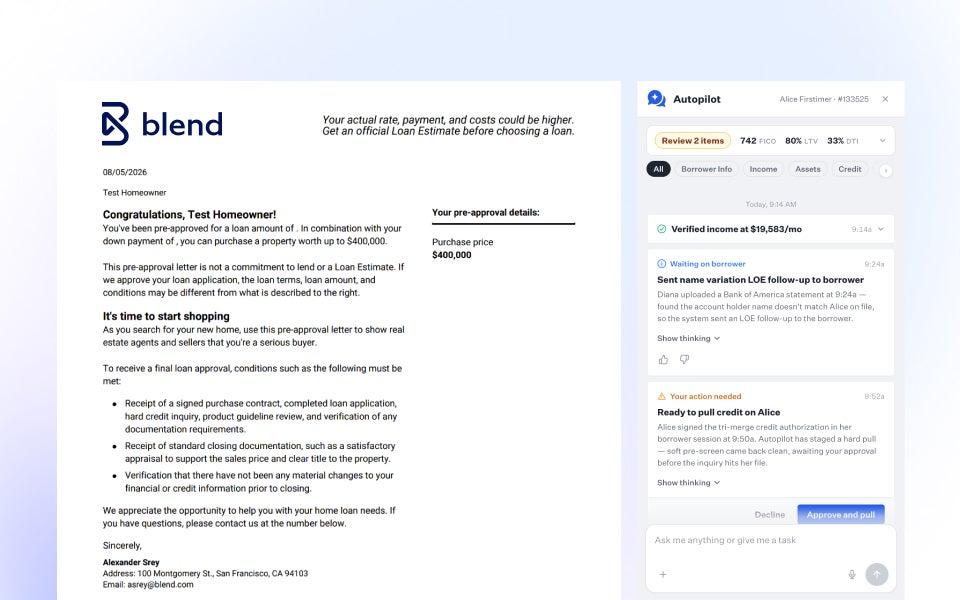
Frost Bank
swapped a friction-filled legacy platform for one seamless experience, and saw application completions jump 60%.
swapped a friction-filled legacy platform for one seamless experience, and saw application completions jump 60%.
Read the full story about Frost Bank
Autopilot Update: The Early Results Are In. Now We’re Making Them Repeatable.
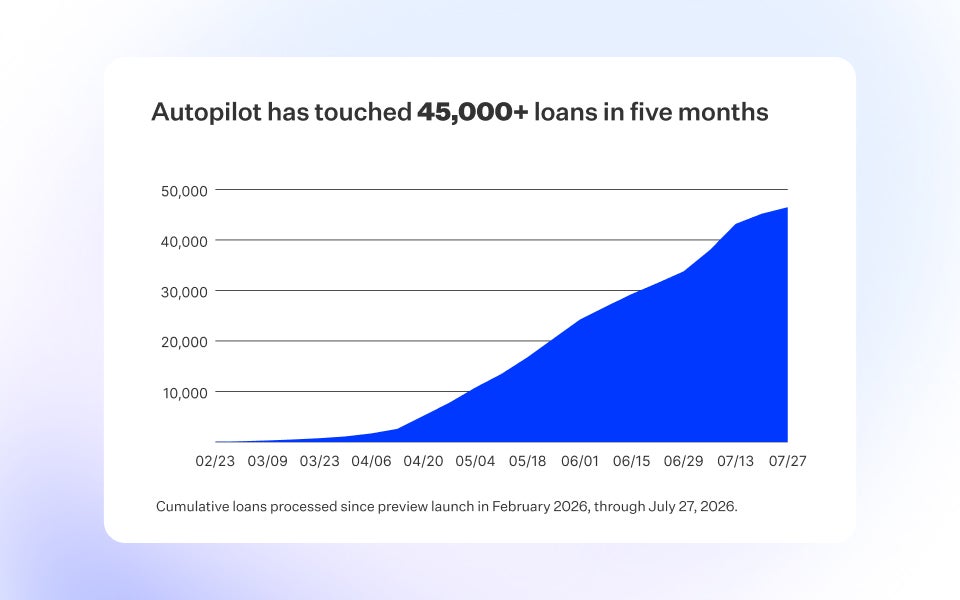
45,000 loans in. See what it took to make Autopilot's early production numbers hold up.
Read the article about Autopilot Update: The Early Results Are In. Now We’re Making Them Repeatable.