
December 1, 2025 in Thought leadership
Unlocking Growth: Deepening customer engagement
American Banker's editorial team sits down with Blend to discuss how banks can leverage technology, data, and AI to forge stronger, more profitable customer relationships.

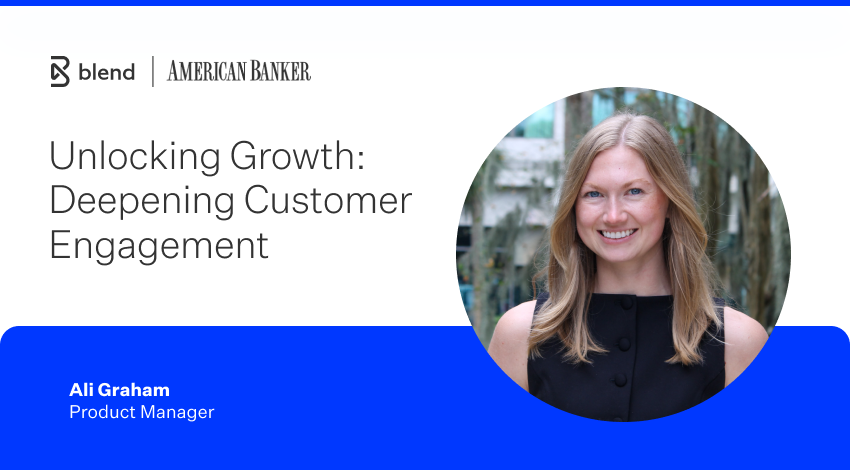
In this podcast, part of our Unlocking Growth series with American Banker, Ali Graham, Lead Product Manager of Consumer Banking at Blend, explores how financial institutions can meet rising consumer expectations. She details the critical role of data and AI in delivering proactive, hyper-personalized recommendations, like loan offers, that address customer pain points. Ali stresses that a consistent, modern omnichannel experience is essential for building trust and customer bonds across digital and in-person channels. Discover how removing friction is key to accelerating growth and positioning your bank as an essential financial partner.
Transcript
Michael Moser, American Banker (00:03):
Banks and lenders are turning to new solutions to create frictionless customer entry points and make it easier for banking consumers to open any type of account, whether it be a loan deposit account, credit card, or mortgage, to strengthen customer engagement and ultimately grow wallet share. Banks need to take a holistic view of their people and processes to see how new and innovative technologies can improve relationship building, whether that be through targeted and simplified cross-selling or debt consolidation methods, there are many options to consider. Hello, I’m Michael Moser, senior content strategist at American Banker, and in today’s podcast, unlocking Growth, deepening Customer Engagement. I’m excited to be joined by two industry experts at Blend, Ali Graham, lead product manager and consumer banking, and Suman Atwal Lead commercial and product council to discuss how banks can build stronger customer bonds. Welcome Ali and Suman. Thank you for joining us.
Ali Graham, Blend (01:03):
Thank you for having us, Michael. We’re excited to be here.
Suman Atwal, Blend (01:07):
Thanks, Michael. Looking forward to the discussion.
Michael Moser, American Banker (01:09):
Well, Ali, to start things off, can you share your perspective on how banks are looking to build deeper relationships with our customers?
Ali Graham, Blend (01:17):
It’s a great question to start out with. Before we jump in, I think it’s important that we think from the perspective of today’s consumer. I think we can all relate that we want our financial institutions to be more than just a place to hold money. We are looking to them to understand our individual needs and offer tailored services and advice. I have come to expect that when I open my online banking app, it’s just as easy as when I open Amazon or Netflix, for example. So with that in mind, there’s a few strategies that we see that are being employed to drive deeper engagement. First, we can’t start the conversation without talking about data. There is a huge opportunity to leverage this and AI to provide proactive and hyper personalized recommendations and cross-sell offers. This inherently enables banks to forge deeper and more meaningful relationships that is based not just in transactions, but delivering value. Another thing that is worth calling out is that digital will, while critical, especially for these upcoming generations, the in-person experience remains crucial. According to Deloitte’s research, 70% of consumers consider a consistent experience across channels to be important in choosing their primary bank. So I think that stat alone really reinforces this notion that delivering omnichannel experiences is important to meet your customer wherever and whenever they want to interact. Another interesting stat that I saw that I think is relevant to the conversation is that according to Forrester, a one point improvement in the CX index score can lead to an incremental 123 million in revenue for a large multichannel bank. So here we can’t underscore enough that there’s a huge importance in delivering a consumer experience that is modern and seamless, and being able to deliver that starts with investing in the right technology.
Michael Moser, American Banker (03:25):
That’s amazing. 1% can deliver a hundred million in revenue, and I definitely agree with that Deloitte study you mentioned, the omnichannel experiences, it’s very relevant for today’s consumer, me especially. But I’m curious, how can technology and a digital experience enable financial institutions to deliver consistent and seamless customer interaction, say for example, with a cross sell or debt consolidation?
Ali Graham, Blend (03:54):
Well, Michael, this is the right question to ask because it’s something that I spend all day every day thinking about by putting the customer at the center of the experience. I truly believe that banks can move beyond simply just offering products and truly become that trusted financial partner. And there are a few ways in which I view technology playing a role here. So as I mentioned previously, financial institutions have this wealth of customer data and how can they leverage this to create engaging experiences. One example that comes to mind is personalized offers. Michael, which is more engaging to you? A message that says you’re pre-qualified for an auto loan or save $200 per month on your car loan by switching to us.
Michael Moser, American Banker (04:44):
Definitely the latter. I definitely would like to save $200 a month.
Ali Graham, Blend (04:48):
Yes, I think we can all agree there, and I think the reason is because it addresses a pain point. We all, as consumers are thinking about how can we save, how can we cut down on our monthly expenses, especially in today’s environment, and a message like that by leveraging technology to identify an opportunity presented at the opportune moment is more likely to drive action from the consumer and create a really meaningful moment of engagement. You can also take it a step further by, let’s say you had just opened up a mortgage and now you’re offering up a credit card to them from that experience, how can you pre-populate that credit card application? So they simply have to confirm a few of their details without the hassle of starting a brand new application. I think those moments of reducing friction are really key here. Another thing that comes to mind is on this topic of consumers being really mindful of employing strategies to save, there’s an opportunity that banks have to deliver these experiences. And so within debt consolidation specifically at Blend, we’re investing in tools that allows the consumer to view their full debt profile and select which accounts they want to pay off as part of their loan application. As a consumer, this is exactly what I’m wanting my bank to provide to me, ways for me to save. They’re being proactive, they’re keeping me in mind and for financial institutions, you also can benefit through leveraging these tools because you can approve more creditworthy applicants by leveraging this data in your decisioning and you can originate healthier loans from the start.
Michael Moser, American Banker (06:35):
I like the reduction of friction. I love the idea of the dashboards. That’s certainly something that I could see as being critical for the consumer as well as something that the bank can offer.
Ali Graham, Blend (06:46):
I think one other thing that we touched upon earlier is this concept of needing to deliver a really consistent, great experience in the branch. And I think there’s a good opportunity that banks have to drive engagement through offering a modern omnichannel experience to meet consumers wherever they’re choosing to interact. And this means that the customer’s journey is unified across all channels, that if I start an application online and I come into the branch, I’m not forced to repeat the same information that I had just provided maybe a day or two ago that you really understand me and as the consumer, you make me feel valued no matter whether I pick up the phone or I go online. And I think building that consistent experience is a core part of how I think about approaching building product.
Michael Moser, American Banker (07:44):
Suman, I’d love to get your perspective on this.
Suman Atwal, Blend (07:47):
Absolutely. From a legal and compliance perspective, to be able to support new technologies and all of the strategies that Ali just mentioned, including all the tools that we are providing through our products and services, we really take a compliance forward approach, which means making sure that the products are offered and presented in ways that are fair, they’re clear and they’re consistent. We strive to ensure that safeguards are built into the consumer journey, and by doing so, the goal is to really reduce friction and give financial institutions the confidence to continue to strengthen those long-term relationships that they have with the consumers. And it’s really important to us that we are continuing to work towards striking this balance between technology, consumers and their expectations and what financial institutions are looking for to make sure that technology isn’t just working to make things faster, it’s making engagement more sustainable for the long term.
Michael Moser, American Banker (08:51):
Sounds like you’re saying the innovation journey is as important as the innovation itself.
Suman Atwal, Blend (08:58):
Absolutely. The way that innovation is delivered is absolutely just as important as the innovation itself. And we really lean into ensuring that our product team has the resources and the guidance to make sure that we are continuing to work and able to provide that innovation to our financial institutions to support their consumers.
Michael Moser, American Banker (09:20):
So, let’s talk about AI. It’s very topical these days and we’d be remiss not to cover it. How do you see the role of AI changing how banks engage with their customers? And Ali, let’s start with you.
Ali Graham, Blend (09:34):
You’re right, Michael. This is a very hot topic, not only internally with our customers, but also in the market as a whole. So at least the way that I see it, this is going to transform how banks interact with customers and how they deliver value. And there is an immediate future with these technologies, but there’s also something that we need to look ahead and financial institutions need to plan for. In the immediate future, I view AI as really playing a role in improving efficiency and the quality of customer service. This is the easiest use case to tackle because it is in some ways the lowest risk, right? A trend report showed that 77% of consumers say that AI is helpful for simple issues. If financial institutions can find ways to incorporate AI to help surface a variety of routine inquiries, that enables them to provide round the clock assistance, eliminate wait times, and provide an uplift and that overall customer experience while also still keeping a human in the loop for those more complex, important conversations.
Michael Moser, American Banker (10:54):
Makes sense.
Ali Graham, Blend (10:55):
But let’s get to the fun part, which I think is where the future of this is going. When you think about the concept of a personal AI agent, I think this is going to completely revolutionize the way that consumers and banks interact with each other. Let’s imagine this: I have a personal agent, I want a new credit card, and I say, “hey, find me the top three credit card offers.” Instead of myself working with maybe perhaps my primary bank or going online, my AI agent is now going to use data such as my spending habits, my search history, my goals that they might have access to, and use that to surface up opportunities for me in the market. And so this new paradigm is really going to change the way that financial institutions interact, and I think they need to start thinking through strategic technology investments and how eventually to optimize their marketing spends so that they are the ones being recommended to these agents.
Michael Moser, American Banker (12:07):
I like the idea of a personalized agent because then it’ll probably surface things that I may have overlooked. And if it’s tailored to my spending habits as you mentioned, then it probably is more appropriate for my needs.
Ali Graham, Blend (12:21):
Absolutely.
Michael Moser, American Banker (12:23):
Suman, anything you’d like to add?
Suman Atwal, Blend (12:25):
Absolutely. I think we can all agree that AI is everywhere and in financial services, I believe that it represents one of the most exciting opportunities, especially to deepen customer engagement. But we also understand that with that opportunity comes responsibility. The responsible use of AI is absolutely critical in a sector that is as heavily regulated and trust-based as financial services. We understand this deeply, and we are committed to continue innovation not just for innovation’s sake, but to really help our customers, our financial institutions deliver transformative technology to consumers. But at the same time, we also have a deep understanding that financial institutions are regulated entities. They have clear priorities when it comes to compliance, governance, and protecting consumer trust. And we absolutely strive to take those priorities seriously. And now we can attest to this, we usually lockstep from product ideation to go to market and build the products together. So for us, innovation and compliance are not in conflict. They’re aligned, they reinforce each other, they build long-term trust, and we strongly believe that we’re not just managing risk, we’re building a foundation that our customers can really rely on, and that foundation accelerates technology adoption and unlocks growth. And we really believe that that’s how AI becomes more than just a buzzword that we’re hearing often enough. It becomes a strategic enabler, not just for innovation, but for scalable growth in financial services.
Michael Moser, American Banker (14:09):
Thanks for that perspective. That was very helpful. So as we wrap up today’s conversation, Ali, do you have any parting words or advice to our listeners as they strive for simple and modern customer interactions?
Ali Graham, Blend (14:21):
Thank you, Michael, again, for having us. It’s been really enjoyable chatting with you. As I think about parting words, I think the key thing for financial institutions today to keep in mind is that when you want to drive deeper engagement with your customers, the key is to create simple and modern interactions. Every time a customer has to repeat information, navigate to a confusing interface or get stuck in a silo channel, you’re just introducing friction, and that friction eventually is going to erode trust. So the takeaway that I have for our listeners is to look for every opportunity to remove those roadblocks. Another thing that I think is worth calling out is how can you begin shifting your mindset into this new age of technology? Timely example may be instead of asking what loan are you asking for, how much do you need? Try asking what are you looking to achieve and how can you incorporate that mindset shift not only across your teams that are in the branch on the phone, but also from a technology perspective? Because again, this approach will build trust and position you as an essential partner in their financial journey, which will eventually build deeper and deeper engagement. I think by focusing on these principles, today’s banks cannot only meet but also exceed the rising expectations of today’s customers.
Michael Moser, American Banker (15:51):
That makes a lot of sense. Well, folks, that’s all the time we have for today. Ali and Suman, thank you for joining us to help banks deepen customer engagement.
Ali Graham, Blend (16:00):
Thank you, Michael. It was great chatting with you.
Suman Atwal, Blend (16:02):
Thank you so much for having us.
Michael Moser, American Banker (16:04):
And thanks to our listeners for tuning in. To learn more about how Blend can help you modernize your technology landscape to build long lasting customer relationships, please visit blend.com.