April 8, 2026 in Blend momentum
Blend Autopilot Week 5 Update: Autopilot MCP Server Ships, Opening the Full Lending Platform to AI Agents
Autopilot Weekly Update: Week 5

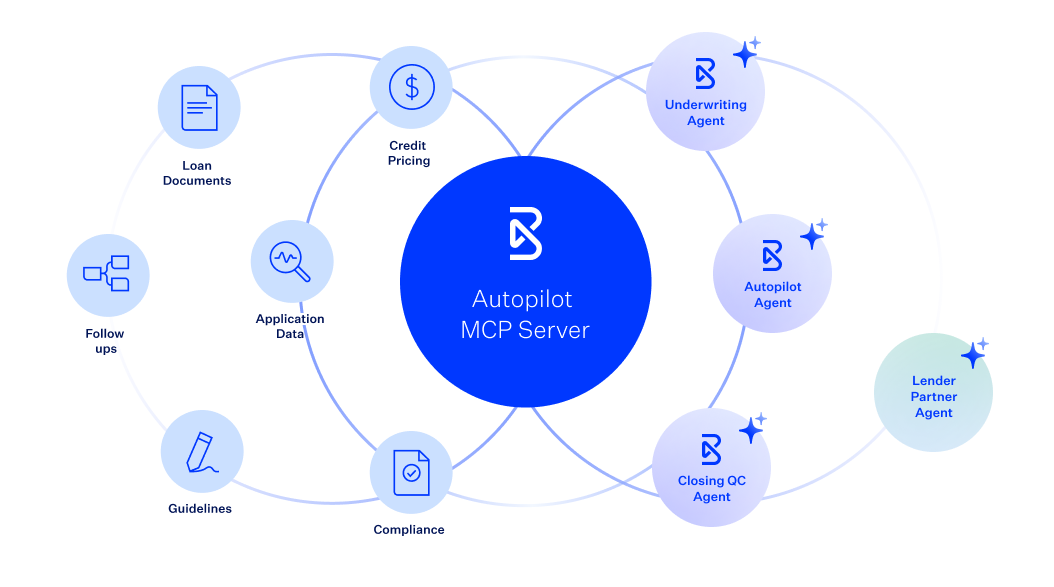
This is the biggest update since Autopilot launched. The team shipped Autopilot MCP, an MCP server that gives AI agents programmatic access to the full Blend lending platform, spanning credit, pricing, underwriting, compliance, documents, and more. It’s live in beta, and lenders are already building on it.
Three things make this significant. It gives Blend’s own agents, starting with Autopilot and expanding to new agents the team is actively building, a single infrastructure layer to operate through. It turns the full lending platform into an AI-accessible toolset, with dozens of tools covering every major area of the lending lifecycle, accessed through one standardized interface. And it lays the foundation for lenders and partners to build their own AI-powered workflows on top of Blend.
Subscribe to Autopilot updates
AI agents now have access to the full lending platform
MCP is an open protocol that standardizes how AI agents connect to the platforms they operate on. Without it, every new AI capability would require its own custom integration to each system it needs to touch. Credit would need an integration. Pricing would need another. Documents would need another. That doesn’t scale. MCP eliminates that. One connection, full platform access.
Blend built its MCP server to span the full lending lifecycle:
- Loan data and documents: Applications, borrower profiles, document uploads and downloads, and borrower requests and follow-ups.
- Credit, pricing, and rate locks: Pull credit reports, generate pricing quotes, and lock rates.
- Automated underwriting: Submit to DU and LPA, and retrieve findings.
- Mortgage insurance: Calculate MI scenarios across providers and premium types.
- Disclosures, eSign, and title: Send initial and closing disclosures, initiate electronic signatures, and order title.
- Compliance, conditions, and loan status: Generate compliance reports, manage conditions, and advance milestones.
- Communications: Email and SMS to borrowers.
When an AI agent needs to check a borrower’s credit, it pulls the actual credit report. When it looks at pricing, it queries the real pricing engine. When it checks compliance, it runs against the actual compliance rules. Not a knowledge base. Not a cached summary. The live systems, through one standardized interface.
One infrastructure layer for every Blend agent
Autopilot is the first agent on this platform, but it won’t be the last. The team is actively building new agents, and each one will operate through this same layer from day one. No rebuilding integrations for each new capability. One platform, shared across every agent Blend ships.
The full platform, AI-accessible
Until now, Autopilot operated on documents, income, and follow-ups. With the MCP server, it has access to everything: credit, pricing, AUS, mortgage insurance, disclosures, conditions, compliance, loan status, and more. Agents understand how these domains relate to each other and can navigate the full workflow on their own. They can pull credit, check pricing, verify compliance, submit to underwriting, all in the right sequence without manual orchestration. This is the infrastructure that turns a document review agent into a lending agent.
The foundation for lender and partner-built AI
The same interface that powers Blend’s agents is designed to be opened up. Lenders are already connecting their own AI agents to the MCP server in beta, building workflows tailored to how they operate. The same standardized access to the full platform that Blend’s agents use is available for lenders and partners to build on.
If you’re building AI-powered workflows and want to connect to the Blend platform, the Autopilot MCP server is available in beta today. Contact your Blend account team to get access. Self-serve enablement is coming soon.
Enterprise controls for AI agents are built in
Opening up the platform to AI agents means the controls have to be right from the start. They are.
Per-tenant access gating. Every request goes through Blend’s Dynamic Config Service. Access is controlled per lender, so capabilities can be enabled for specific tenants without affecting anyone else. If DCS is unreachable, the system fails closed. No access by default.
Full audit trail. Every tool call, every agent action, persisted to a durable audit log. What the agent did, when, on which loan, and what data it accessed. When a compliance team needs to understand why an agent took a specific action, the full record is there.
Dedicated credentials. The MCP server uses its own set of Lending API credentials, isolated from other services. The principle of least privilege applies, so agents only have access to the specific APIs they need.
Beta mode. Destructive and irreversible operations (rate locks, credit pulls, borrower-facing sends, loan cancellations, disclosure delivery) are excluded in beta. Lenders get full read access and safe write operations first. Destructive operations open up when they’re ready.
Autopilot now defends against prompt injection attacks
Prompt injection is one of the most discussed risks in AI systems. An attacker embeds instructions inside a document or message, hoping the agent will follow them instead of its own guidelines. For an AI agent with access to the full lending platform, this matters even more.
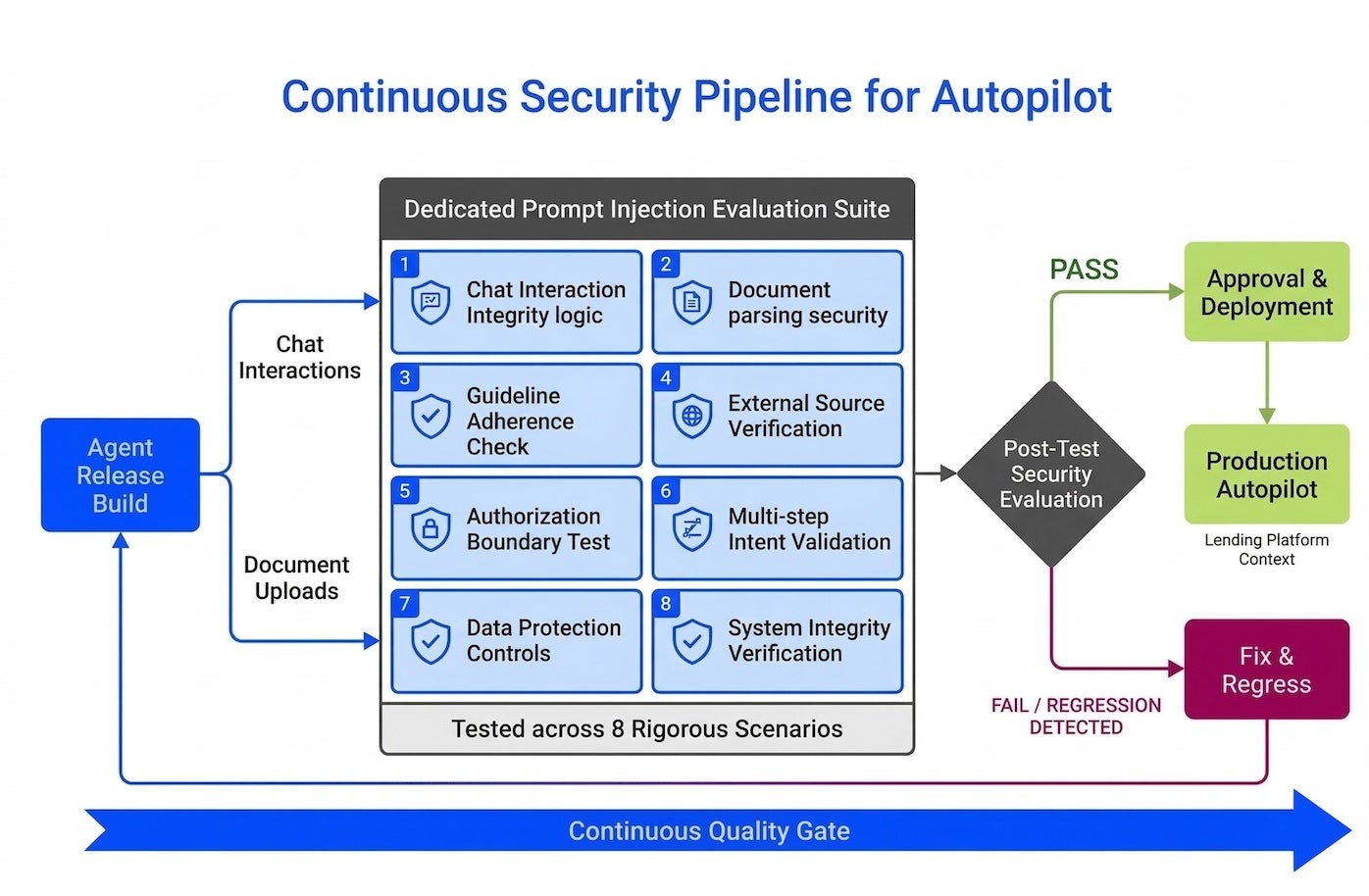
The team shipped a dedicated prompt injection evaluation suite with eight attack scenarios that run continuously against Autopilot, testing the agent’s resilience across document uploads and chat interactions and covering the attack vectors that security researchers and red teams focus on.
Every agent build is tested against these scenarios before it reaches production. If a new capability introduces a regression in security posture, we catch it before it ships. This isn’t a one-time audit. It’s a continuous quality gate on every release.
Borrower data scoping is reinforced
Autopilot has always operated within Blend’s existing access control framework. Borrower data stays within the borrower’s context. This week, the team reinforced that foundation as borrower chat gets closer to launch.
Every tool the agent uses in a chat session (document retrieval, follow-up status, application data, income findings) is now explicitly scoped to the authenticated borrower at the tool level. This adds a second layer of enforcement on top of the platform’s existing access controls. Even if a future code change introduced an unexpected path, the tool-level scoping would prevent cross-borrower data access independently.
Defense in depth, applied to the AI agent the same way it’s applied to every other part of the platform.
Custom guideline support is more accurate
Lenders running portfolio products, HELOCs, or proprietary overlays use Autopilot’s custom guideline mode, where the agent applies lender-specific rules instead of (or in addition to) standard GSE guidelines.
We fixed an issue where the agent was injecting standard guideline context into custom guideline sessions. When a lender is running custom mode, the agent now reasons purely against their rules, without interference from guidelines that don’t apply to that product.
For lenders with non-agency products, this means more accurate findings and fewer false positives on document review.
Document upload processing is more reliable
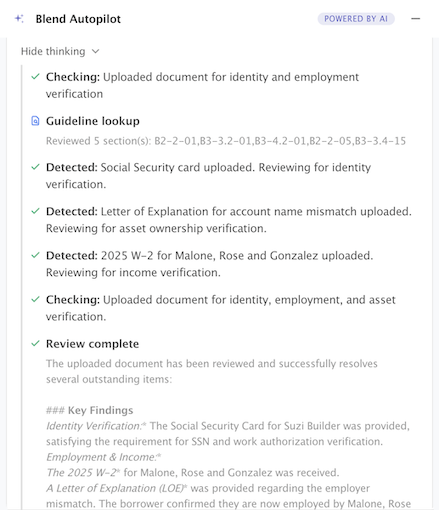
We resolved an issue where certain upload event configurations could cause the agent to miss a trigger, meaning a document would land in the loan file without the agent processing it.
That’s fixed. Document uploads now reliably trigger agent processing regardless of how the upload event is configured. If a document hits the loan, Autopilot sees it.
Performance and safety improvements under the hood
Beyond the headline features, the team shipped a series of quality, reliability, and infrastructure improvements:
- Guideline retrieval performance: Added a caching layer for guideline lookups, reducing redundant retrievals during document review. The agent is faster on loans with many documents.
- Environment-based thinking optimization: The agent now uses different reasoning depth levels depending on environment, extending thinking where it matters and optimizing for cost where it doesn’t.
- Expanded evaluation coverage: Major expansion of the end-to-end evaluation suite, including post-submission scenarios, follow-up resolution validation, and agent reasoning quality checks. The quality gates are deeper than they’ve ever been.
- Eval duration monitoring: New CI check that catches performance regressions in evaluation runs, so if the agent gets slower, we know before it ships.
- Content safety infrastructure: Model Armor, Google’s content safety layer, now supports GCP service account authentication for broader deployment flexibility.
- Borrower chat buildout continues: Identity-aware context, loan-type-agnostic responses, and follow-up tool improvements. All building toward launch.
What’s next for Blend Autopilot
The MCP server is live and powering Blend’s agents. New agents are actively in development, each one building on the same platform infrastructure.
Borrower chat and loan officer chat continue to progress. The enterprise controls, audit trail, and security hardening shipped this week aren’t just for Autopilot. They’re for every agent that will operate on this platform.
With the MCP server in place, the agent now has the infrastructure to access credit, pricing, fees, DU results, and more. The roadmap is no longer limited by integration work. The platform is open.
Every improvement ships automatically to every lender with Autopilot activated. No upgrade cycles. No implementation projects. The agent gets better every week.
If you’re building AI-powered workflows and want to connect to the Blend platform via MCP, contact your Blend account team to get started in your beta environment. Self-serve enablement is coming soon.
We’ll be back next Wednesday with what’s new.
Blend Autopilot is currently in preview and free to activate and use during the preview period for all Blend customers. To get started, visit your Lending Config Center or contact your Blend account team.
We publish a new update every Wednesday. Subscribe to the Autopilot weekly update to make sure you stay up to date with everything we are shipping.
Find out what we're up to!
Subscribe to get Blend news, customer stories, events, and industry insights.
Next-Level Growth: Closing the Execution Gap in 2026
Join Blend, Cornerstone Advisors and, People First FCU, as they operationalize the findings of the Next-Level Growth: Credit Union Opportunities in a Changing Market report.
Watch video about Next-Level Growth: Closing the Execution Gap in 2026
Blend Autopilot Week 4 Update: Borrower Chat Is Coming, API-Uploaded Documents Now Visible to Autopilot, and Smarter Cross-Document Analysis
Real adoption, real feedback. See how lenders are shaping what Autopilot has become this week.
Read the article about Blend Autopilot Week 4 Update: Borrower Chat Is Coming, API-Uploaded Documents Now Visible to Autopilot, and Smarter Cross-Document Analysis
Reduce Pre‑Closing Delays with Refreshable Asset‑Based Employment Checks
Learn how refreshable, asset‑based employment checks can reduce pre‑closing delays, cut last‑minute outreach, and align with DU®, LPA®, and agency expectations.
Read the article about Reduce Pre‑Closing Delays with Refreshable Asset‑Based Employment Checks