November 17, 2025 in Thought leadership
Unlocking Growth: The Credit Union Playbook
American Banker’s editorial team sits down with Blend to talk about strategic growth strategies for credit unions.

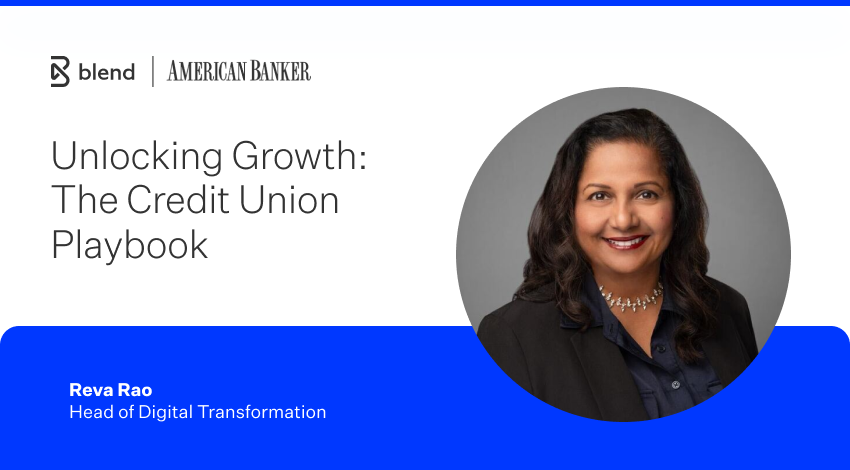
In this podcast, part of our Unlocking Growth series with American Banker, Reva Rao, Head of Digital Transformation at Blend, gets deeper into the topic of growth strategies, discussing how credit unions can drive growth by enhancing the member experience for lasting relationships. She discusses how credit union members differ from customers of large national and global banks, and how credit unions can turn operational efficiency and personal member support into a true competitive advantage, delivering speed without sacrificing the member relationship.
Transcript
Michael Moser – American Banker (00:03):
Hello everyone. I’m Michael Moser with American Banker. I’ll be your host and moderator for today’s podcast. As digital experiences become table stakes, close to a third of credit unions struggle to integrate digital and in-person experiences. Fintechs are adding to this urgency by raising the bar on speed and simplicity and credit unions are rising to the challenge while determined to preserve the personal and community focused service that sets them apart. 46% of credit union leaders say delivering a better omnichannel customer experience is their top growth priority for the next 12 months. In today’s podcast, Unlocking Growth, I’m excited to be joined by Reva Rao, Head of Digital Transformation at Blend, to get deeper into this topic and to discuss how credit unions can amplify their member growth and enhance the member experience for lasting relationships. Welcome Reva. Thank you for joining us.
Reva Rao – Blend (01:04):
Thank you, Michael. I’m very excited to be here.
Michael Moser – American Banker (01:08):
Super well. Now, Reva, you’ve worked in Australia and in the US with large firms like National Australia Bank or NAB and Citi before coming to the US to work with Wells Fargo, JPMorgan Chase and others. You clearly have an ability to understand how people connect to banks across cultures, different banking types and different needs. How are credit union members different in their needs from people who bank with the mega banks?
Reva Rao – Blend (01:38):
Yeah, great question. I think the best answer would be to talk about the credit union mindset. They often value belonging to an institution that’s member owned and deeply connected to the community. Then just being a customer of a big financial institution. The second is members expect a more personalized service. So credit union members are usually generational. Michael, their grandparents who open accounts and parents have their first accounts, and now the grandkids will inherit a CD for an example. So a CU member or credit union member wants to be treated as individuals and not numbers. So there’s a bigger emphasis on relationships and trust. And then finally, what the biggest differentiation is credit unions are mission driven, so they focus on local impacts, they impact local communities, and they focus on member wellbeing, which appeals to members seeking that kind of ethical, responsible financial partners.
Michael Moser – American Banker (02:39):
Well, that brings up a question in terms of digital transformation, which is the big thing today. Why can digital transformation be such a tricky subject when it comes to credit unions?
Reva Rao – Blend (02:54):
Yeah, well, the most obvious one and the easiest to answer this question, so I’ll put it in a couple of bullets, is the first one is resource constraints. Remember, credit unions are using the member deposits to fund their institutions. So they have typically smaller, less budget tech resources. So that’s the number one reason they do not have big bank funds and resources. The second is legacy systems. Usually credit unions take a longer time, they’re running on older technology, making that integration with modern fintechs and APIs super challenging because it’s a harder integration for them. The third I would say, which is I think very close and near and dear to my heart, which was a challenge, is fractured leadership priorities. Credit unions tend to have leaders focused on distinct silos. The head of deposits focuses on deposit partnerships. The head of lending as the chief lending officer, I focused on lending. So there’s a disconnect between transformation and what they want to do to increase production as an example. And finally, which is obviously the biggest bane of every credit union and credit union leader’s life is regulatory complexity. And I’ll say that again, regulatory complexity, meaning compliance, security expectations while introducing new techs are very daunting. And it’s hard because you don’t want to be that one credit union pulled up by the NCUA on an audit and asked, why did you do this? So there’s a lot of fear in that.
Michael Moser – American Banker (04:31):
That makes total sense. I can certainly see regulation overshadowing the whole process. But in today’s fast paced financial services market, oftentimes banking leaders get overwhelmed by the latest hot trends, cloud migration, we had core modernization. Now we’re in the age of AI, and often they overlook the functionality of these trends and give us too much focus on that shiny new object. And obviously as you just mentioned, worrying about the compliance factor, but you recently spoke about embedded digital lending that empowered a credit union member to get an HVAC loan on their lunch break to fix a broken air conditioner. And this resonated with me because that happened to be as well. But while many of this focus on this embedded finance solution, can you talk to us about what adopting this new tech gives credit unions and building loyalty and serving their members?
Reva Rao – Blend (05:29):
Certainly, and thank you for referencing that. It’s one of my favorite stories in terms of success and the wow moments we talk about. But really, people don’t wake up in the morning and say they want a personal loan or an auto loan or a mortgage. They wake up saying, I’d like to bring my kids to school, or I’d like to have a home for my family, or I’d like to get a new HVAC system. So focus on the outcomes. We’re just a means to an end. So it’s not tech for tech’s sake. It’s about removing a friction from a member’s lives and enabling, whether it’s HVAC financing or solving a real need, a marriage financing for their child’s wedding, or figuring out how they’re going to pay for school’s education. It’s meeting a real stressful moment with empathy and support that I think will build loyalty. So I call embedded solutions in real life moments, is that part of that credit union movement, which is reinforcing our trust, making ourselves the invisible helpers and partners in the member journeys. And the differentiation is to be able to use the high tech, like what Blend provides the omnichannel experience with the high touch care, which is what the credit union provides. So kind of the marrying of the two is I think the perfect solution.
Michael Moser – American Banker (06:53):
Well, I think that’s a great segue in terms of the outcomes because we, as you mentioned, don’t think about getting an HVAC loan. We think about fixing the air conditioning system. I think it’s a great segue to talk more about raising the bar on delivering better member experiences. And we know that members expect a fast and seamless service with now the average digital account opening time being between six and a half and eight minutes. I’ve got three questions here, and I know the first one sounds a bit crazy. First is six to eight minutes to open a new account to Fast. I mean, a credit union is supposed to know its members, but how can you do that in six minutes?
Reva Rao – Blend (07:34):
Yeah. Well, I would say six and eight minutes is not too fast, but fast onboarding is an advantage, no question, but it should never come at the expense of the value that you provide with your digital tools. It’s very important to understand the member’s needs. And going back to what I previously mentioned, digital efficiency should coexist with thoughtful, personalized interaction. And you use data and you use follow-up journeys. But more importantly, you need to understand your members. And if you have siloed fractured systems operating, it’s hard to know your member, then you don’t know. I often say credit unions call their customers members, but when they come back for a loan, they treat them like strangers. The only way you can make that experience frictionless, is if you truly know your member and you truly tie the systems together.
Michael Moser – American Banker (08:31):
Now that six to eight minutes, that’s certainly rather quick. I guess, do you see that fast account openings can give the credit unions that can deliver on that promise an edge over other institutions that may take longer?
Reva Rao – Blend (08:46):
Yeah, definitely. I think members are increasingly looking for a faster experience. We’ve been spoiled by big tech, right? We go to these big accounts and order systems and within two days they arrive at our door. So we’re increasing that benchmark experience. We already know our baseline is looking at these experiences, but I consider that simpler. So members are saying, make it easy for me, make it simple for me, make it faster for me and make it personalized for me. So I think we’re moving away from just being fast to being a more simpler, easier, and more personalized service.
Michael Moser – American Banker (09:28):
I think you may have just answered one of my other questions. The third one was, are you seeing any other shifts in member expectations for account opening? You did mention fast, you did mention speed, simplicity. Is it personalization or are there other shifts that you’re seeing?
Reva Rao – Blend (09:45):
Yeah, I would say, and I often used to say to my team members, don’t wake up. The one thing COVID taught us was members don’t wake up between nine to five when banks are open, or credit unions are open, right? They are waking up at 9:00 PM at night after they’ve put the kids to bed to realize that they need to serve those financial needs, or God forbid, at 3:00 AM. So members expect to start and finish whenever and wherever. So that omnichannel experience is actually very critical. They need to be able to begin online pause because they didn’t have a question answered. They want to be able to walk into a branch and then get the flexibility to say, these are the things that I’d like to do, and these are the must haves I need to finish these loans.
Michael Moser – American Banker (10:36):
Now, Reva, as we started this podcast, we mentioned earlier that nearly half of all credit union leaders say that delivering a better omnichannel experience is a top growth priority, and then you just reiterated it. Now, members don’t think in channels, as you mentioned earlier, they think of outcomes fixing that AC, getting the car to take the kids to school. So whether they’re starting a conversation online or on the phone or at a branch, they expect that connected consistent experience. How can credit unions break down channel silos that you just mentioned and deliver that unified experience?
Reva Rao – Blend (11:13):
Yeah, no, great question. And I think that’s where the Blend success metric comes in. You equip your staff with tools and data that allows them to have the conversation regardless of channel, right? You can build processes around the member goals and not a long organizational structure. Allow a loan to be finished, started online and to be finished in branch, but make sure that the data and the context carries over so that the branch member who’s attending to the member doesn’t question all the same questions that the member answered online and leverage some of these open API interactions. So modern platforms like Blend help unified data and create interaction histories across digital and physical touchpoints. So you can actually marry those two and allow the back office team track and co-pilot with the member who’s come to your branch because he wasn’t able to finish something online. So making that simple and easy is I think the ultimate, I would say, a solution for any of these members.
Michael Moser – American Banker (12:17):
Yeah, I hate starting something in one channel and then restarting the whole process. I can certainly see that.
Reva Rao – Blend (12:23):
Yeah.
Michael Moser – American Banker (12:25):
I’m curious in terms of how can AI and automation help modernize operations and processes? And we’ve been talking about that unified experience, bringing something from one channel to another since it’s a big topic and can easily overwhelm someone or even an entire credit union board. Can you guide us on how credit unions get started? What should they consider as reasonable KPIs to measure success?
Reva Rao – Blend (12:56):
I would say I think there is a fear that AI is new and AI is going to take away a lot of that kind of personalized service. But remember, we were using AI already. Lending was based on a set number of attributes that gave the people the ability to get a loan. So we’ve been using AI, it’s just not come in this big agentic AI kind of way. And so I would say AI can automate a lot of repetitive tasks, make things that are easy, whether it’s to look up VIN numbers and Blend has tools to help with that flag risk, any kind of fraud activity, you have so many ways of looking at that or personalized recommendations per member. So I would say start with focused pilots. Identify one single process, whether it’s onboarding or loan decisioning, and build a pilot that can be iterative. So you can look at whether it’s account opening or cycle times, look at member satisfaction changes, reduction in manual effort or errors, say yes or no faster instead of sitting in that maybe land, which a lot of lending activities are. And look at measure conversion across sell rates.
Michael Moser – American Banker (14:14):
Got it. Focus pilots, single processes, build things that are iterative. That’s great. Now, when it comes to member growth, it seems that many institutions prioritize acquisition efforts, but many credit unions realize that onboarding is a missed opportunity as new members stall out early in the relationship due to these clunky and impersonal experiences, which are too fast, like the six minute conversation we had earlier. Can you share with us some insights that you’ve learned from Credit Union Round Tables Blend has hosted earlier this year regarding the onboarding process and what actions can they take to turn member onboarding into a growth engine?
Reva Rao – Blend (14:58):
Yeah, Michael, thank you. I love the round tables. Our partners treat us not as a vendor. They’re not clients. We’re not a vendor. We’re actually partners working through the need to make automation faster and simpler. Like I talked about before, members using Blend, as you know, have achieved 80% conversion, 1.5% higher pull throughs, or 50% faster time to close, and their tangible improvements in both member and staff experience. So it’s great because what this does is it allows the round table members to feed off each other’s learnings and understand from each other what they’re doing. Blend has empowered credit unions to deliver efficient modern digital experiences while preserving the truly valuable community oriented service that sets them apart. So a lot of the round table discussion is around automated application routing or instant decisioning using the integrated data that Blend provides, and looking at prequalification tools that Blend has, that allows them to look at instant decisioning, but also look at prequalifications that allow them to grow their channels individually. So it’s more about the partnership and allowing credit unions to help each other through some of their successes and also share some of their learning. So it’s a really great way for us to come together and for credit unions to share with us what they have learned, and for Blend to be able to intervene and say, have you tried this? Would this solution work better? And that partnership has been wonderful.
Michael Moser – American Banker (16:36):
That sounds fantastic. Reva, as we come to an end here, do you have any final thoughts you’d like to share with us before we wrap things up?
Reva Rao – Blend (16:44):
Absolutely. Credit unions, Michael, sit at the intersection of a trusted high touch service and also need for a digital innovative service by looking at platforms like Blend, which are omnichannel that give you the consumer, the mortgage and the deposit production. You can turn operational efficiency and personal member support into a true competitive advantage, delivering speed without sacrificing that relationship. So the most successful credit unions aren’t just keeping up with trends. They’re leading with empathy, using data and technology to meet their members and guide them towards their financial wellbeing. So focusing on that, focusing on the moments that matter. Empowering your team to serve both the whole human as well as the digital tools you can drive growth, and you will deepen the loyalty and trust that defines the credit union legacy. So I’m excited about what the future holds. I’m excited that we can do this with Blend and credit unions.
Michael Moser – American Banker (17:43):
Well, that’s all the time we have for today, Reva. Thank you for joining us to help credit union leaders on their digital transformation journey.
Reva Rao – Blend (17:51):
Thank you, Michael. It was really great talking to you.
Michael Moser – American Banker (17:54):
And thanks to our listeners for tuning in. To learn more about how Blend can help you drive member growth and loyalty, please visit blend.com.